Reporting Office Rules
(RR)
Reporting Office Rules
Reporting Rules, RR dated 19 May 2026 Entry into force: 1 July 2026
The Reporting Office of SIX Swiss Exchange AG issues the following pursuant to Art. 5 FinfraV-FINMA:
1 Purpose and scope
Pursuant to Art. 39 FMIA, Art. 37 FMIO, Art. 51 FinIA, Art. 75 FinIO, Art. 2–5 FMIO-FINMA and FINMA Circular 2018/2 "Duty to report securities transactions", participants and other Swiss and foreign securities firms (collectively: "those subject to the duty to report") which are admitted to a trading venue are obliged to submit those reports which are necessary to ensure the transparency of securities trading. FINMA Circular 2018/2 specifically sets out the relevant definitions, the principles of the duty to report, reportable trades and how the beneficial owner is to be determined. Comments providing further detail on FINMA Circular 2018/2 and other legal foundations are made in Annex A to these Rules. Trades in securities1 are subject to the duty to report pursuant to Art. 37 FMIO, Art. 75 FinIO and FINMA Circular 2018/2. The SIX Swiss Exchange AG reporting office ("Reporting Office") receives reports, processes them, and charges fees for doing so. Those subject to the duty to report are responsible for fulfilling the reporting obligation. These Reporting Office Rules govern: a) The receipt of reports (section 2 and Annex A); b) The processing of reports (section 3 and Annex B); c) Reporting fees (section 4); d) General terms and conditions, and place of jurisdiction (section 5).
2 Receipt of reports
2.1 Trade Report
Participants admitted to SIX Swiss Exchange AG must submit Trade Reports as follows: ‒ On-exchange, off-order-book trades in accordance with the SIX Swiss Exchange AG Trading Rules, or ‒ Trades outside of SIX Swiss Exchange AG ("off-exchange trades") in accordance with the Reporting Office Rules. Reportable off-exchange trades on SIX Swiss Exchange AG in securities admitted to trading at a Swiss trading venue must be reported to the Reporting Office using a Trade Report. Paragraphs 3 and 4 remain reserved. Trade Reports are not required to be submitted to the Reporting Office for reportable trades in securities admitted to trading at a Swiss trading venue at foreign trading venues or foreign organised trading facility (OTF) if the trade has already been reported to the competent foreign authority in the form of a Trade Report and published by that authority. Foreign branches of Swiss securities firms may fulfil their obligation to submit Trade Reports for trades executed abroad via a foreign reporting office recognised by SIX Swiss Exchange AG. Information from the Trade Report will be published to fulfil SIX Swiss Exchange AG post-trade transparency requirements.
In the Reporting Rules, the term “securities” also includes derivatives.
2.2 Content of Trade Reports
Trade Reports must contain the following information as a minimum: a) Identification of the party subject to the duty to report; b) Transaction type (buy or sell); c) Precise identification of the securities or derivatives in question (attributes such as the ISIN); d) Execution volume (depending on the security a nominal value, number of units or contracts); e) Execution price or price obtained on the market excluding commission and fees (incl. statement of currency); f) Time of execution (date and time); g) Information on whether the trade was a proprietary transaction (trading in own name and for own account) or a client transaction (transaction in own name but for the account of the client); h) Designation of the counterparty; i) Designation of the trading venue where the securities or derivative were traded, or the notification that the transaction was executed outside a trading venue; j) Trade Type: designation which further specifies the report (Annex A).
2.3 Transaction Report
For reportable trades in Swiss securities admitted for trading at a Swiss trading venue, a Transaction Report must be submitted to the Reporting Office. Furthermore, this shall also apply to trades in foreign securities admitted for trading at a Swiss trading venue, ‒ provided the trade is conducted at a Swiss trading venue or ‒ outside a foreign trading venue recognised by FINMA.2 Clause 2.3, paragraph 1 (preceding) also applies to reportable trades in derivatives derived from securities admitted for trading at a Swiss trading venue. Every Transmission of Orders for securities admitted to trading at a Swiss trading venue or for derivatives derived from securities admitted for trading at a Swiss trading venue which ultimately results in a trade must be reported by Transaction Report to the Reporting Office by every party in the transaction chain which is subject to the duty to report. The Transaction Report serves to fulfil regulatory requirements and is not published.
2.4 Content of Transaction Reports
Transaction Reports in the Swiss format must contain the following information as a minimum: a) Identification of the party subject to the duty to report; b) Transaction type (buy or sell); c) Precise identification of the securities or derivatives in question (attributes such as the ISIN or CFI); and additionally in the case of derivatives the name of the underlyings and further determining characteristics of the derivative, namely the classification of the derivative; d) Execution volume (depending on the security a nominal value, number of units or contracts); e) Execution price or price obtained on the market excluding commission and fees (incl. statement of currency); and additionally in the case of derivatives, the further value-determining parameters, depending on the classification of the derivative, namely:
The exception outlined in Annex A Clause 1 Reporting Rules shall remain unaffected.
1. whether it is a call or put option, 2. the strike price, 3. the price multiplier and 4. the term of the contract or the expiry date; f) Time of execution or time of order fulfilment in the case of Transmissions of Orders (date and time); g) Information on whether the trade was a proprietary transaction (trading in own name and for own account) or a client transaction (transaction in own name but for the account of the client); h) Designation of the counterparty or, in the case of Transmissions of Orders: designation of the party to whom the order was transmitted; i) Designation of the trading venue where the securities or derivative were traded, or the notification that the transaction was executed outside a trading venue; j) Information permitting the beneficial owner to be identified, or in the case of Transmissions of Orders: the designation of the party who transmitted the order; k) Transaction identification code (trade ID). The format of the Transaction Report must comply in full with either the Swiss format, as defined in FINMA Circular 2018/2, or with RTS 22 (governed by Clause 2.7.2 below). An indication of the transaction identification code (Trade ID) forms part of a complete report in accordance with the Swiss format or RTS 22 (governed by Clause 2.7.2 below). As an exception to margin number 13 of FINMA Circular 2018/2, FINMA grants an exemption from the requirement to include the transaction identification code (Trade ID) in Transaction Reports relating to trades executed on foreign trading venues, provided that the order is routed via a third-party broker.
2.5 Registration
Those subject to the duty to report must be registered with the Reporting Office before they are able to submit reports. They will receive a registration number. Participants of SIX Swiss Exchange AG are deemed registered.
2.6 Reporting deadlines
During trading hours, Trade Reports must be submitted to the Reporting Office within the following deadlines after the trade has been effected: a) One minute for equities, global depository receipts, rights and options; b) Three minutes for investment funds, Exchange Traded Funds (ETF), Exchange Traded Structured Funds (ETSF), Exchange Traded Products (ETP), Sponsored Funds and Structured Products; c) 15 minutes for bonds. Trade reports for trades in equities and global depository receipts carried out in connection with a delta-neutral hedge with respect to a derivative transaction must be reported within five minutes at the latest. The trades are to be flagged with the trade type “Derivative Hedge” (Annex A). VWAP (Volume Weighted Average Price) trades must be reported with the actual VWAP achieved and using the “Special Price” Trade Type (Annex A) no later than 30 minutes after the close of trading if the trade is an off-order-book fixed price transaction. Trades at a future net asset value are deemed to be effected in accordance with paragraph 1 as soon as the net asset value on which the trade is based is known. The trades are to be reported with the trade type “NAV Trade” (Annex A).
Trade Reports for trades outside of SIX Swiss Exchange AG trading hours must be submitted before the start of trading on the trading day following the trade at the latest. Transaction Reports must be submitted by close of trading on the next trading day at the latest.
2.7 Reporting functions
2.7.1 One-sided and two-sided Trade Reports
Those subject to the duty to report report trades with those not subject to the duty to report in the form of a one-sided Trade Report. Those subject to the duty to report report trades with others subject to the duty to report in the form of a two-sided Trade Report.
2.7.2 Transaction Report format
The Reporting Office accepts full Transaction Reports which comply with the Swiss format, as described in FINMA Circular 2018/2 (margin numbers 27-30), and governed by the technical specifications. The Reporting Office accepts full Transaction Reports in the European Union format as specified in the technical implementing standards (RTS 22) for Art. 26 of Regulation (EU) No. 600/2014 of the European Parliament and of the Council of 15 May 2014 on markets in financial instruments and amending Regulation (EU) No. 648/2012 (MiFIR).
2.8 Correction, cancellation of reports and countertrades
2.8.1 Correction
The party subject to the duty to report may correct the information on whether the trade was a proprietary or a client transaction in a Trade Report. A Trade Report may only be corrected once. The correction must be made at the latest by 10.00 pm (CET) on the trading day following the submission of the report. To correct a Transaction Report, the Transaction Report must be deleted and the corrected Transaction Report must be resubmitted to the Reporting Office by the party subject to the duty to report. The correction must be made at the latest by 10.00 pm (CET) on the fifth trading day following the submission of the report to be corrected.
2.8.2 Cancellation
Trade Reports may be cancelled upon application by the parties involved in the Trade Report. In the case of incorrect Trade Reports (i.e. those which do not comply with Clause 1.1), those subject to the duty to report are obliged to cancel or request the cancellation of the Trade Report. The cancellation must be made by the following trading day at the latest. Should the party subject to the duty to report or the Reporting Office cancel a report, this cancellation will be published.
2.8.3 Countertrades
A party subject to the duty to report may make a countertrade. When reporting the countertrade, the ID of the original trade must be given, and the report must be marked with the "Special Price" Trade Type.
3 Processing of reports
3.1 Information published from Trade Reports
The price, volume and time of the trade are published immediately when a Trade Report is submitted.
3.2 Delayed publication of Trade Reports
Trades in equity securities and illiquid bonds, or large in scale bond trades, may be published with a delay at the request of the party subject to the duty to report. The provisions on delayed publication pursuant to Annex B of these Rules otherwise apply.
4 Reporting fees
The Reporting Office charges a reporting fee for receiving and processing reports. The Reporting Office may charge fees for corrections, deletions, cancellations and countertrades. The applicable rates are set out in the List of Charges under the Reporting Rules.
5 General terms and conditions, and place of jurisdiction
5.1 Emergency situations
Those subject to the duty to report must immediately notify the Reporting Office in the event of an emergency situation (failure of the reporting or access system, force majeure). Emergency situations do not, as a rule, constitute a release from the duty to report. Trade Reports following emergency situations must be marked additionally with the "Special Price" Trade Type.
5.2 Inspection right
The Reporting Office has the right at all times to inspect compliance with legal and regulatory provisions, or to have it inspected. Those subject to the duty to report undertake to permit the office conducting the inspection to inspect all documents and provide such information as is necessary to carry out the inspection. The Reporting Office may invoice those subject to the duty to report for the costs associated with the inspection. The Reporting Office may inform or involve FINMA.
5.3 Confidentiality
The Reporting Office, its governing bodies, staff and agents are subject to professional secrecy pursuant to Art. 147 FinMIA. Notwithstanding statutory provisions to the contrary or rules to the contrary set out in these Reporting Rules, the Reporting Office shall treat as confidential all information which is subject to reporting obligations that it receives in connection with the Reporting Rules. The Reporting Office shall only publish such confidential information, with the exception of that set out in Clauses 3.1 and 3.2, with the consent of the participants concerned. The Reporting Office may disclose data to SIX Group AG companies and/or its staff in Switzerland and abroad, provided the Reporting Office ensures that the group company concerned and/or the staff concerned are bound by confidentiality provisions that are comparable to those of these Reporting Rules. This applies in particular in the context of internal group activities involving more than one company
and/or country, e.g. concerning product developments/improvements, market analyses, marketing, optimisation of customer services and risk management, and to facilitate organisation within the group. The Reporting Office may disclose data to external third parties in Switzerland and abroad necessary for the performance of their contractual duties (in particular central counterparties and settlement organisations), provided the Reporting Office ensures that these parties are bound by confidentiality provisions that are comparable to those of these Reporting Rules. The Reporting Office is authorised to outsource data processing and other services to third parties in Switzerland and abroad, in particular to group companies of SIX Group AG. This concerns, in particular, liquidity management, treasury, risk management, internal auditing, the management of core data, data retention or storage, accounting, personnel, IT and back-office functions, legal and compliance, activities designed to guarantee fair, efficient and orderly trading, and the operating of matching, market and reference data distribution systems. Where data is transmitted to group companies or external third parties as part of an outsourcing arrangement, all service providers will be subject to comprehensive confidentiality provisions.
5.4 Amendments to the Rules
Subject to the approval of FINMA, the Reporting Office may amend the Rules. Those subject to the duty to report will be notified of any amendments on the SIX Swiss Exchange AG website before they come into effect.
5.5 Applicable law and place of jurisdiction
The Rules are subject to Swiss law. The place of jurisdiction is Zurich, Switzerland. The Reporting Office Rules are available in German, French and English. The German version alone of the Reporting Office Rules is binding in the event of inconsistencies between the German, French and English versions.
5.6 Entry into force
The Reporting Office Rules issued on 19 May 2026 by the Management Committee of SIX Exchange Regulation AG and approved by FINMA on 20 April 2026 enter into force on 1 July 2026 and replace the Reporting Office Rules dated 12 May 2025.
Annex A – General Supplements
1 Further information on exemptions from the duty to report
Trades in securities which are admitted to trading on SIX Swiss Exchange AG’s trading segment "Bonds – Non-CHF" (international bonds) but not listed are exempted from the duty to report. However, transactions in the trading segment "Bonds – Non-CHF" are subject to the duty to report if the bond was issued by a company domiciled in Switzerland or by a foreign branch or a subsidiary/sister company of such a company. Also exempted from the duty to report are Transmissions of Orders concerning foreign securities that are admitted to trading at a trading venue in Switzerland, providing the resulting execution has been effected at a FINMA recognised foreign trading venue, or via a recognised foreign organised trading facility (OTF, Organised Trading Facility / Systematic Internaliser) (clarifying information in respect of FINMA Circular 2018/2, margin number 24 and art. 37 para. 4 let. b FinMIO and art. 75 para. 4 let. b FinIO). Remote members of a Swiss trading venue are also exempted from the duty to report (clarifying information in respect of FINMA Circular 2018/2, margin number 25, first sentence): a) In the case of trades in non-Swiss securities outside of Switzerland between two remote members of a Swiss trading venue ‒ outside of a trading venue; or ‒ at a trading venue not recognised by FINMA; or ‒ via an organised trading facility/systematic internaliser (OTF, Organised Trading Facility / Systematic Internaliser); b) In the case of trades in non-Swiss securities outside of Switzerland between a remote member of a Swiss trading venue and a Swiss counterparty subject to reporting requirements (the Swiss counterparty remains subject to the duty to report) ‒ at a trading venue not recognised by FINMA; or ‒ via an organised trading facility/systematic internaliser (OTFS, Organised Trading Facility / Systematic Internaliser).
2 Trade Types
Trade Types for Trade Reports: a) "Special Price" specifies a report, the price of which differs from the market price at the time of entry (VWAP, portfolio trade, countertrade, Trade Report following an emergency situation, etc.). b) "Deferred Publication" specifies a report which is to be published by the Exchange after a certain delay. c) "Off-Exchange" specifies a report of a trade which is not subject to the provisions of the Trading Rules. d) "Both Parties" specifies a one-sided Trade Report which is reported to the Exchange in the name of both of the parties involved in the trade. e) “Derivative hedge” specifies a report for a trade made in connection with a delta-neutral hedge with respect to a derivative transaction. f) “NAV Trade” flags a report for a trade that is reported with a net asset value as soon as this value is known.
If an off-order-book trade meets the requirements for delayed publication at the end of the trading day and if the Trade Report is submitted after 15:30 (CET), the Exchange will delay publication of the trade until 09:00 (CET) on the following trading day. The Exchange publishes the authoritative ADT per security, with the static data, on the Exchange website: www.six-group.com/en/products-services/the-swiss-stock-exchange/market-data/statistics/yearlyreports.html
2 Bond market
At the request of the participants, the Exchange shall publish off-order-book trades with a delay.
2.1 Illiquid securities
The participant may apply for delayed publication if all of the following provisions are fulfilled: a) the trade is executed off-order-book; and b) there is no liquid market for the security. There is deemed to be no liquid market for a security if one or more of the following criteria is/are not met: Average nominal value of trades per trading day during a < CHF 100,000 or the equivalent amount for securicalendar year ties with a foreign nominal currency. Average number of trades per trading day during a calendar < 15 year Average number of trading days on which traded during a < 80% calendar year Issue size during a calendar year a) for government bonds < CHF 1 billion or the equivalent amount for securities with a foreign nominal currency; or b) for other bonds < CHF 500 million or the equivalent amount for securities with a foreign nominal currency.
In the case of newly issued securities for which no data exists for the past three months, there is deemed to be no liquid market if the size of the government bond issue is less than CHF 1 billion and the issue size for other bonds is less than CHF 500 million (or the equivalent amount for securities with a foreign nominal currency). The Exchange publishes the authoritative liquidity data per security, with the static data.
2.2 Liquid securities
2.2.1 Large in scale trades by a systematic internaliser (SSTI threshold)
The participant may apply for delayed publication if all of the following provisions are fulfilled: a) the trade is executed off-order-book; b) there is a liquid market for the security; c) the trade was executed by a systematic internaliser for its own account ("Principal"); and d) the required minimum volume of the trade corresponds to the size specific to the instrument (SSTI) threshold of the securities concerned.
The required minimum trade volume for large in scale trades by a systematic internaliser (the SSTI threshold) corresponds to the 80th percentile of trading turnover on the exchange of the liquid securities in question during one calendar year, and is rounded down in each case to the nearest CHF 100,000. The Exchange publishes the value of large in scale trades by a systematic internaliser (the SSTI threshold) per security with the static data.
2.2.2 Large in scale trades (LIS threshold)
The participant may apply for delayed publication if all of the following provisions are fulfilled: a) the trade is executed off-order-book; b) there is a liquid market for the security; c) the required minimum volume of the trade corresponds to the large in scale (LIS) threshold of the securities concerned. The required minimum trade volume for large in scale trades (the LIS threshold) corresponds to the 90th percentile of trading turnover on the exchange of the liquid securities in question during one calendar year, and is rounded down in each case to the nearest CHF 100,000. The Exchange publishes the value of large in scale trades (the LIS threshold) per security with the static data.
Annex B – Delayed Publication
1 | Equity market | ||
At the request of the participants, the Exchange shall publish off-order-book trades with a delay. The par- | |||
ticipant may apply for delayed publication if all of the following provisions are fulfilled: | |||
a) the trade is executed off-order-book; | |||
b) the trade is concluded between a participant trading on its own account (nostro) and a client of this | |||
participant; and | |||
c) the required minimum volume of the trade corresponds to the average daily turnover (ADT) in the se- | |||
curities in question. | |||
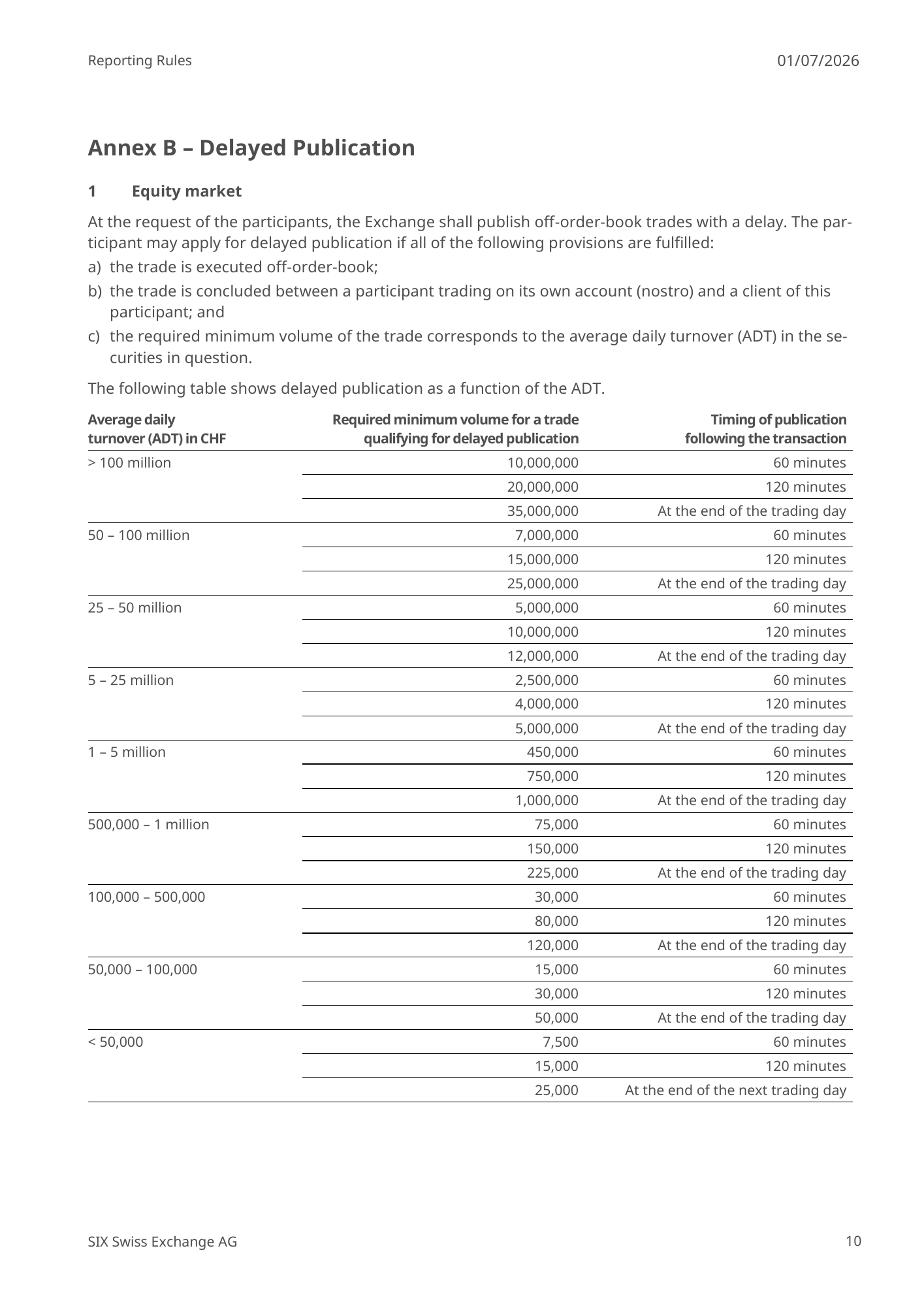
The following table shows delayed publication as a function of the ADT. | |||
Average daily | Required minimum volume for a trade | Timing of publication | |
turnover (ADT) in CHF | qualifying for delayed publication | following the transaction | |
> 100 million | 10,000,000 | 60 minutes | |
20,000,000 | 120 minutes | ||
35,000,000 | At the end of the trading day | ||
50 – 100 million | 7,000,000 | 60 minutes | |
15,000,000 | 120 minutes | ||
25,000,000 | At the end of the trading day | ||
25 – 50 million | 5,000,000 | 60 minutes | |
10,000,000 | 120 minutes | ||
12,000,000 | At the end of the trading day | ||
5 – 25 million | 2,500,000 | 60 minutes | |
4,000,000 | 120 minutes | ||
5,000,000 | At the end of the trading day | ||
1 – 5 million | 450,000 | 60 minutes | |
750,000 | 120 minutes | ||
1,000,000 | At the end of the trading day | ||
500,000 – 1 million | 75,000 | 60 minutes | |
150,000 | 120 minutes | ||
225,000 | At the end of the trading day | ||
100,000 – 500,000 | 30,000 | 60 minutes | |
80,000 | 120 minutes | ||
120,000 | At the end of the trading day | ||
50,000 – 100,000 | 15,000 | 60 minutes | |
30,000 | 120 minutes | ||
50,000 | At the end of the trading day | ||
< 50,000 | 7,500 | 60 minutes | |
15,000 | 120 minutes | ||
25,000 | At the end of the next trading day |