641.711
Ordinance
on the Reduction of CO2 Emissions
(CO2 Ordinance)
of 30 November 2012 (Status as of 1 November 2020)
Preamble
The Swiss Federal Council,
on the basis of the CO2 Act of 23 December 20111 (CO2 Act),
ordains:
Chapter 1 General Provisions
Section 1 Greenhouse Gases
Art. 1
This Ordinance regulates the reduction in the emission of the following greenhouse gases:
carbon dioxide (CO2);
methane (CH4);
nitrous oxide (N2O);
hydrofluorocarbons (HFCs);
perfluorocarbons (PFCs);
sulphur hexafluoride (SF6);
nitrogen trifluoride (NF3).
The warming effect of greenhouse gases on the climate is converted into the equivalent quantity of CO2 (CO2eq). The values are listed in Annex 1.
Section 2 Definitions
Art. 2
In this Ordinance:
2passenger cars means passenger cars in accordance with Article 11 paragraph 2 letter a of the Ordinance of 19 June 19953 on Technical Requirements for Road Vehicles (RVTRO); in terms of this Ordinance, special-purpose vehicles in accordance with Annex II Part A point 5 of Directive 2007/46/EC4 are not deemed to be passenger cars;
abis. 5vans means vans in accordance with Article 11 paragraph 2 letter e RVTRO; in terms of this Ordinance, vans with an unladen weight of over 2585 kg measured using the measurement procedure for heavy-duty vehicles in accordance with Regulation (EC) No 595/20096 and for which no emission values in accordance with Regulation (EC) No 715/20077 are available, and special-purpose vehicles in accordance with Annex 2 Part A point 5 of Directive 2007/46/EC are deemed not to be vans;
ater. 8light articulated vehicles means articulated vehicles in accordance with Article 11 paragraph 2 letter i RVTRO with a total weight of no more than 3.50 t; in terms of this Ordinance, articulated vehicles with a unladen weight of over 2585 kg, measured using the measurement procedure for heavy-duty vehicles in accordance with Regulation (EC) No 595/2009 and for which no emission values in accordance with Regulation (EC) No 715/2007 are available, and special-purpose vehicles in accordance with Annex 2 Part A point 5 of Directive 2007/46/EC are deemed not to be light articulated vehicles;
9...
10rated thermal input means the maximum possible supply of heating energy per unit of time for an installation;
11total rated thermal input means the sum of the rated thermal inputs of an installation operator’s fixed installations that are taken into account in the emissions trading scheme (ETS);
total output means the sum of the delivered electrical and thermal nominal output of a fossil-thermal power plant;
overall efficiency means the ratio of total output to the rated thermal input of a fossil-thermal power plant in accordance with the manufacturer's specifications.
Section 3 Sectoral Interim Targets
Art. 3
The interim targets for 2015 are:
for the building sector: no more than 78 per cent of 1990 emissions;
for the traffic sector: no more than 100 per cent of 1990 emissions;
for the industry sector: no more than 93 per cent of 1990 emissions.
If a sector-specific interim target listed in paragraph 1 is not achieved, then the Federal Department of the Environment, Transport, Energy and Communications (DETEC), after hearing the cantons and affected parties, shall request the Federal Council for additional measures.
Section 4 Counting Emission Reductions achieved Abroad12
Art. 4 Eligible emission reductions achieved for projects abroad13
Emission reductions achieved abroad may only be counted by installation operators and persons authorised by this Ordinance.
Emission reductions achieved abroad may be counted if:
they are attested to by an emission-reduction certificate of the United Nations Framework Convention on Climate Change (UNFCCC) of 9 May 199214; and
Annex 2 does not preclude their being counted.
Art. 4a15 Letters of approval for projects
Installation operators or persons wishing to obtain emission-reduction certificates for an emission-reduction project abroad can apply to the Federal Office for the Environment (FOEN) for the necessary letter of approval in accordance with the rules of Article 6 paragraph 3 or Article 12 paragraph 5 of the Kyoto Protocol of 11 December 199716 to the United Nations Framework Convention on Climate Change (Kyoto Protocol).
The FOEN issues a letter of approval if the requirements of Article 4 paragraph 2 letter b are met.
Section 5 Attestations for Domestic Emission-reduction Projects and Programmes
Art. 5 Requirements
Attestations for emission reductions from domestic projects and programmes are issued if:
Annex 3 does not preclude them;
the project or programme’s planned component activities:
would not be economically feasible without revenues from the sale of the attestations,
meet(s) at least the current state of the art, and
provide(s) for measures that lead to an increase in emission reductions as measured against the reference scenario defined in Article 6 paragraph 2 letter d;
the emission reductions:
are verifiable and quantifiable,
18are not greenhouse gas emissions that are recorded by the ETS, and
19were not achieved by an operator with a reduction obligation under Article 66 paragraph 1 that at the same time is applying for attestations under Article 12; the foregoing does not apply to operators with reduction obligations with an emissions target under Article 67, provided the emission reductions from projects and programmes are not included in the emissions target; and
the beginning of the implementation of the project or programme does not predate the submission of an application in accordance with Article 7 by more than three months.
The time when the applicant makes a significant financial commitment to a third party or itself takes organisational measures relevant to the project or programme is deemed the beginning of implementation.
Art. 5a Programmes
Planned component activities can be grouped together into one programme if:
they have a common purpose in addition to reducing emissions;
they apply one of the specified technologies in the programme description;
they fulfil the inclusion criteria specified in the programme description, which guarantee that the planned component activities meet the requirements of Article 5; and
implementation has not yet begun.
Planned component activities can be included in existing programmes if they meet the conditions of paragraph 1 and had already been demonstrably registered in the programme before the inclusion.
Programmes that only comprise one planned component activity on expiry of the first crediting period shall be continued as projects under Article 5.20
Art. 6 Validation of projects and programmes
Installation operators or persons wishing to apply for attestations for an emission-reduction project or programme must have it validated at their own expense by a validator approved by the FOEN.
A description of the project or programme is to be submitted to the validator. This must include information about:
the measures for reducing emissions;
the technologies applied;
the delimitation from other climate and energy policy instruments;
the hypothetical progression of greenhouse gas emissions if the emission-reducing measures of the project or programme were not implemented (reference scenario);
total expected annual emission reductions and the underlying calculation method;
the organisation of the project or programme;
the anticipated investment and operating costs and expected revenues;
the financing;
the monitoring plan, in which the start date of the monitoring is defined and the methods for accounting for emission reductions are described;
21the duration of the project, the programme and the individual planned component activities;
for programmes, in addition: the purpose, the criteria for the inclusion of planned component activities in the programme, the administration of the planned component activities as well as an example of a planned component activity per specified technology.
In the case of projects and programmes in connection with a local heating network or landfill gas projects and programmes, the description of the information requested in paragraph 2 letters d, e and i shall meet the requirements of Annexes 3a or 3b.22
For the validation the validator examines the information specified in paragraph 2 and whether the project meets the requirements of Article 5 or the programme meets the requirements of Articles 5 and 5a respectively.
It summarizes the results of the examination in a validation report.
Art. 7 Application for the issuance of attestations
An application for the issuance of attestations must be submitted to the FOEN. It must include the project or programme description and the validation report.
The FOEN may request additional information from the applicant if required for evaluating the application.
The FOEN shall specify the form of the project or programme description.23
Art. 8 Decisions about the qualification of a project or programme
The FOEN decides whether a project or programme qualifies for issuance of attestations on the basis of the application.
The decision is valid for seven years from the start of the implementation of the project or programme (crediting period).
No attestations are issued for planned component activities of programmes if:
a change in applicable legal provisions results in emission-reduction measures that must be implemented during the crediting period;
the issuance of attestations is for claimed emission reductions attributable to the implementation of measures described in letter a; and
implementation of the planned component activities had started after the change in legal provisions comes into force.
Art. 8a Extension of the crediting period
The crediting period is extended for successive three-year periods if the applicant has the project or programme revalidated and submits an application for extension to the FOEN no later than six months before the end of the crediting period.
The FOEN approves the extension if the requirements referred to in Articles 5 and 5a are still met.
Art. 9 Monitoring report and verification of the monitoring report
The applicant collects all the required data in accordance with the monitoring plan and records them in a monitoring report.
The applicant has the monitoring report verified at its own expense by a FOEN-approved verifier. The verification may not be done by the same entity that has validated the project or programme.
The verifier examines whether the accounted-for emission reductions meet the requirements of Article 5. For programmes it also examines whether the planned component activities meet the inclusion criteria of Article 5a paragraph 1 letter c. It may limit the verification to a single representative planned component activity.
The verifier records the results of the verification in a verification report.
All monitoring reports and the corresponding verification reports must be submitted to the FOEN at least every three years following the start of implementation under Article 5 paragraph 2. The emission reductions must be disclosed per calendar year.24
The FOEN shall specify the form of the monitoring report.25
Art. 10 Issuance of attestations
The FOEN shall examine the monitoring report and the corresponding verification report. Where required in order to issue attestations, the FOEN shall conduct further enquiries relating to the applicant.26
It shall decide whether to issue attestations on the basis of the information mentioned in paragraph 1.27
Attestations for projects are issued for the extent to which emission reductions have demonstrably been achieved up to the end of the crediting period.
Attestations for programmes are issued for the extent to which emission reductions have demonstrably been achieved for no longer than ten years after the end of the programme’s crediting period, if the relevant planned component activity has been started during the crediting period.
Emission reductions that are attributable to non-refundable payments from the Confederation, cantons or communes for promoting renewable energies, energy efficiency or climate protection are only attested to the applicant if it proves that the responsible public bodies have not otherwise claimed the emission reductions. Emission reductions that are attributable to funds obtained on the basis of Article 19 in conjunction with Article 21 or of Articles 25, 27, 32 and 73 paragraph 4 of the Energy Act of 30 September 201628 (EnA) are not attested.29
The added ecological value of emission reductions is compensated with the issuance of attestations. If the added ecological value has already been compensated for, no attestations are issued.
Art. 11 Substantial modifications to the project or programme
Substantial modifications of the project or programme carried out after the decision has been made regarding qualification or the extension of the crediting period must be reported to the FOEN.
A modification to the project or programme is in particular deemed substantial if:
actual emission reductions deviate from the expected annual emission reductions specified in the project or programme description by more than 20 per cent;
actual investment or operating costs deviate from the values specified in the project or programme description by more than 20 per cent.
If necessary, the FOEN orders a revalidation. Emission reductions achieved after a substantial modification are only attested in accordance with a new decision on qualification in accordance with Article 8.
After revalidation, from the time the substantial modification is made the crediting period lasts for:30
seven years if the crediting period has not yet been extended;
three years if the crediting period has already been extended.
Section 5a. Attestations for Installation Operators31
Art. 1232 Attestations for installation operators with reduction obligations33
Installation operators with reduction obligations under Article 66 paragraph 1 to which an emission target under Article 67 applies and which are not carrying out any projects or programmes in accordance with Article 5 or 5a that result in emission reductions covered by the emissions target shall be issued with attestations for domestic emission reductions on application if:
the installation operator credibly reports that its emissions target will be reached without counting emission-reduction certificates;
the installation’s greenhouse gas emissions in the relevant year have been reduced by more than 5 per cent compared with the reduction course determined in accordance with Article 67; and
for emission-reduction measures, the installation operator has received no non-refundable payments from the Confederation, cantons or communes for promoting renewable energies, energy efficiency or climate protection or from surcharges obtained in accordance with Article 35 EnA34 for geothermal power, biomass and waste from biomass; excepted from this are installation operators that had already registered for the receipt of such funds before the amendment of 8 October 201435 came into force.36
Attestations are issued for emission reductions to the extent of the difference between the reduction course minus 5 per cent and the greenhouse gas emissions in the relevant year, for the last time in 2020.
...37
Art. 12a38 Attestations for installation operators with a target agreement regarding the progression of energy consumption39
Installation operators that have agreed with the Confederation on targets for the progression of energy consumption and also have commitments to reduce CO2 emissions (target agreement with an emissions target), without being exempt from the CO2 levy for this purpose, are issued attestations for domestic emission reductions on application if:
the target agreement with an emissions target meets the requirements of Article 67 Paragraphs 1–3, is validated at the operator’s own expense by a FOEN-approved validator and has been assessed by the FOEN as qualified;
the operator submits a monitoring report annually no later than 31 May in accordance with Article 72;
the installations’ CO2 emissions during the preceding three years have in each year fallen short of the agreed reduction course in the target agreement with emissions target by more than 5 per cent; and
for emission-reduction measures, the operator has received no non-refundable payments from the Confederation, cantons or communes for promoting renewable energies, energy efficiency or climate protection or from surcharges obtained in accordance with Article 35 paragraph 1 EnA40 for geothermal power, biomass and waste from biomass; excepted from this are operators that had already registered for the receipt of such funds before the amendment of 8 October 201441 came into force.42
The validated target agreement with emissions target must be submitted to the FOEN no later than 31 May of the year in which attestations are being applied for.
Substantial and permanent changes under Article 73 as well as changes under Article 78 must be reported to the FOEN. If necessary, the FOEN orders a revalidation.
Attestations are issued for emission reductions to the extent of the difference between the reduction course minus 5 per cent and the greenhouse gas emissions in the relevant year, for the last time in 2020.
Section 5b. Administration of Attestations and Data Protection43
Art. 1344 Administration of attestations and data
Operators and persons that have applied for the issuance of attestations must at the same time provide the FOEN the account to which the attestations should be issued. Attestations are issued and administered in the Emissions Trading Registry in accordance with Articles 57–65.45
The following data and documents are managed in a FOEN-administered database:
first names, surnames and contact information of the applicant, the validator and the verifier;
the number of attestations issued;
the core data for the project or programme; and
the project and programme description, the validation reports, the monitoring reports and the verification reports.
On request, the holder of an attestation is granted access to the data described in paragraph 2 letters a and b in connection with the attestation. Access to the data and documents described in paragraph 2 letters c and d may be granted subject to the preservation of manufacturing and trade secrecy.
Art. 1446 Publication of information on projects and programmes
The FOEN may, subject to preservation of manufacturing and trade secrecy, publish:
a. descriptions of domestic emission-reduction projects and programmes;
b. validation reports in accordance with Article 6 paragraph 4;
c. monitoring reports in accordance with Article 9 paragraph 1;
d. verification reports in accordance with Article 9 paragraph 4.
2 Before publication, the FOEN shall provide the applicant with the documentation specified in paragraph 1. It shall require the applicant to indicate the information that in the applicant’s opinion is subject to manufacturing and trade secrecy.47
Section 6 Coordination of Adaptation Measures
Art. 15
The FOEN coordinates the measures specified in Article 8 paragraph 1 of the CO2 Act.
It thereby takes account of the cantons’ measures.
The cantons regularly inform the FOEN about their measures.
Chapter 2 Technical Measures for Reducing CO2 Emissions from Buildings
Art. 16
The cantons regularly report to the FOEN on technical measures for reducing CO2 emissions from buildings.
The report must contain information regarding:
the CO2 measures taken and planned and their effectiveness; and
the progression of CO2 emissions from buildings within the canton.
On request, the cantons make available to the FOEN all necessary documents that form the basis of the report.
Chapter 3 Measures for reducing CO2 Emissions from Passenger Cars, Vans and Light Articulated Vehicles
Section 1 General Provisions
Art. 17
The provisions of this Chapter apply to any person who imports into Switzerland or manufactures in Switzerland a passenger car, van or light articulated vehicle which is then registered for the first time. The condition of the vehicle when first registered is decisive.
Vehicles registered for the first time in Switzerland are deemed registered for the first time; excluded are vehicles that have been registered abroad for more than six months before a customs declaration in Switzerland.
Registration in a customs enclave in accordance with Article 3 paragraph 3 of the Customs Act of 18 March 200549 (CustA) and in Liechtenstein is deemed registration in Switzerland. Registration in a customs enclave in accordance with Article 3 paragraph 2 CustA, with the exception of Liechtenstein, is deemed registration abroad.
If the deadline specified in paragraph 1 leads to the significant unequal treatment of importers of vehicles that have already been registered abroad before a customs declaration in Switzerland and importers of vehicles that have not been registered abroad before a customs declaration in Switzerland, or should misuses occur, then DETEC may:
a. shorten or extend the deadline by no more than one year;
b. define a required minimum number of kilometres covered.
5 The reference year is deemed to be the calendar year in which achievement of the individual target is verified.
Section 2 Importer and Manufacturer
Art. 18 Major importer
An importer is deemed to be a large-scale importer of passenger cars in the reference year in relation to its fleets of new vehicles if at least 50 passenger cars from these fleets were registered for the first time in the year before the reference year.
An importer is deemed to be a large-scale importer of vans or light articulated vehicles in the reference year in relation to its fleets of new vehicles if at least six such vehicles from these fleets were registered for the first time in the year before the reference year.
Art. 19 Provisional treatment as a large-scale importer
An importer may apply to the Swiss Federal Office of Energy (SFOE) to be provisionally treated as a large-scale importer in the reference year in relation to its fleets of new vehicles if no more than 49 passenger cars or, where applicable, no more than five vans or light articulated vehicles were registered for the first time from these fleets in the year before the reference year.
Passenger cars or, where applicable, vans or light articulated vehicles that are registered for the first time in the reference year after the date on which the application in terms of paragraph 1 is approved shall be included in the relevant fleet of new vehicles.
If no more than 49 passenger cars or, where applicable, no more than five vans or light articulated vehicles are registered for the first time in the reference year, the importer must account individually for each vehicle in the relevant fleet of new vehicles.
Art. 20 Small-scale importers
An importer is deemed to be small-scale importer be in relation to its fleets of new vehicles in the reference year if it registered no more than 49 passenger cars or, where applicable, no more than five vans or light articulated vehicles from its fleets for the first time in the year before the reference year and if it is not provisionally treated as a large-scale importer in the reference year.
Art. 21 Manufacturer
Depending on the number of a manufacturer’s vehicles that are registered for the first time in the year before the reference year, either the provisions of this Chapter for large-scale importers or those for small-scale importers apply to that manufacturer by analogy in the reference year.
Art. 22 Emission pools
Importers and manufacturers that wish to be treated as an emission pool must apply to the SFOE by 30 November of the year before the reference year to be treated as an emission pool for a duration of one to five years.
An emission pool must appoint a representative.
Section 3 Bases for Assessments
Art. 23 Documentation to be submitted
A vehicle imported by a large-scale importer may not be registered until the Federal Roads Office (FEDRO) has, by submission of a type approval, been notified of the data required for calculating any sanction and for the allocation of the vehicle to a fleet of new vehicles.
In the case of vehicles without type approval, the large-scale importer must submit the following documentation to FEDRO before the vehicle is registered for the first time:
the completed inspection report in accordance with Article 6 paragraph 3 of the Ordinance of 19 June 199550 on the Type Approval of Road Vehicles (RVTAO);
the application for attestation; and
any evidence required in accordance with Article 25 paragraph 1 or 2.
A vehicle imported by a small-scale importer may be registered for the first time if the small-scale importer has paid FEDRO the sanction in accordance with Article 13 of the CO2 Act where a sanction is due, and has submitted the following documentation:
the completed inspection report in accordance with Article 6 paragraph 3 RVTAO;
the application for attestation;
any evidence required in accordance with Article 24 paragraph 1 or 3 or Article 25 paragraph 1 or 2.
If an importer wishes to have a vehicle that it has imported accounted for in the fleet of new vehicles of a large-scale importer, it must notify FEDRO of this before the vehicle is registered for the first time by applying for attestation. The application must include the signature of the large-scale importers assuming responsibility.
Art. 24 CO2 emissions and unladen weight of vehicles with type approval
To determine the CO2 emissions and the unladen weight of vehicles with type approval, the data in the type approval in accordance with the RVTAO are decisive, unless the importer submits the data in accordance with paragraphs 3 or 4 to FEDRO before the deadline.
If details of the unladen weight are not included in the type approval of vans and light articulated vehicles, the unladen weight recorded at the vehicle inspection in the inspection report in accordance with Article 6 paragraph 3 RVTAO is decisive.
The importer may submit the following data based on the certificate of conformity (COC) in accordance with Article 18 of Directive 2007/46/EC51 FEDRO within the deadline in paragraph 5:
for passenger cars, vans and light articulated vehicles:
the vehicle identification number (VIN),
the CO2 emissions (combined) in accordance with Position 49.1,
any eco-innovations, and
the unladen weight if available in accordance with Position 13.2, otherwise in accordance with Position 13;
for vans and light articulated vehicles with multi-stage type approval in accordance with Article 3 point 7 of Directive 2007/46/EC in order to determine the CO2 emissions and unladen weight of the completed vehicle in accordance with Annex XII point 5 of Regulation (EC) No 692/200852:
the data in accordance with letter a points 1–3,
the unladen weight of the basic vehicle, and
the technically permitted total weight of the basic vehicle when laden.
For vehicles with type approval that are converted to use a different fuel before the vehicle is registered for the first time, the evidence in accordance with Article 25 paragraph 1 letters b–d must be submitted to FEDRO within the deadline in accordance with paragraph 5.
The data and evidence in accordance with paragraphs 3 and 4 must be submitted by the 31 January following the reference year or, in the case of a small-scale importers, before the vehicle is registered for the first time.
In order to verify the data in accordance with paragraphs 3 and 4, FEDRO and the SFOE may require the importer to submit the COC in original form.
Art. 25 CO2 emissions and unladen weight of vehicles without type approval
In determining the CO2 emissions and unladen weights of vehicles that are exempt from type approval (Art. 4 RVTAO53), the following evidence is decisive:
the data based on the COC in accordance with Article 24 paragraph 3 letter a;
written evidence contained in an inspection report from an inspection centre listed in Annex 2 RVTAO (conformity assessment) or a foreign inspection centre (conformity certificate) that the vehicle complies with the Swiss regulations;
the approval of a foreign state in accordance with national or international law that is listed in Annex 2 RVTRO54 or which is at least equivalent to the Swiss regulations; or
the inspection report from an inspection centre that is competent in accordance with Annex 2 RVTAO or which has been provisionally licensed by FEDRO in accordance with Article 17 paragraph 2 RVTAO.
If the vehicle is a van or a light articulated vehicle with a multi-stage type approval in accordance with Article 3 point 7 of Directive 2007/46/EC55, in determining the CO2 emissions and unladen weights of the completed vehicle the evidence in accordance with paragraph 1 letters b–d and in accordance with Article 24 paragraph 3 letter b is decisive.
In the case of vehicles for which evidence in accordance with paragraph 1 or 2 is not available, the CO2 emissions are calculated in accordance with Annex 4. The unladen weight in kg in accordance with Article 7 RVTRO is decisive. The importer must provide proof of this unladen weight value in the form of a certificate of weight.
If the CO2 emissions of a vehicle cannot be calculated in accordance with paragraph 3, passenger cars shall be assumed to produce emissions of 300 g CO2/km and vans and light articulated vehicles 400 g CO2/km.
Art. 26 CO2-reducing factors for vehicles
A reduction in the average CO2 emissions of a fleet of new vehicles in the case of large-scale importers or, where applicable, in the CO2 emissions of a vehicle in the case of small-scale importers achieved by using recognised innovative technologies in accordance with Article 12 of Regulation (EC) No 443/200956 or in accordance with Article 12 of Regulation (EC) No 510/201157 (eco-innovations) shall be taken into account to the extent of no more than 7 g CO2/km.
For vehicles that can be fuelled by a mixture of natural gas and biogas, the SFOE shall reduce the level of CO2 emissions by the percentage of the recognised biogenic component in accordance with Article 12a paragraph 2 of the Energy Efficiency Ordinance of 1 November 201758.59
Art. 27 Calculating the average CO2 emissions for large-scale importers
The average CO2 emissions of a fleet of new vehicles of a large-scale importer is calculated based on the arithmetical mean of the CO2 emissions of the passenger cars or, where applicable, vans and light articulated vehicles of the large-scale importer registered for the first time in the reference year, rounded to three decimal places.
In order to calculate the average CO2 emissions of a fleet of new vehicles in accordance with paragraph 1, the following percentage of vehicles from the fleet of new vehicles with the lowest CO2 emissions in the reference years 2020–2022 shall be taken into account:
in the reference year 2020: 85 per cent;
in the reference year 2021: 90 per cent;
in the reference year 2022: 95 per cent.
In order to calculate the average CO2 emissions of a fleet of new vehicles in accordance with paragraph 1, vehicles with CO2 emissions of less than 50 g CO2/km shall be taken into account up to a reduction in the average CO2 emissions of the fleet of new vehicles of a maximum total of 7.5 g CO2/km for the reference years 2020–2022 as follows:
in the reference year 2020: double;
in the reference year 2021: 1.67 times;
in the reference year 2022: 1.33 times.
Art. 28 Individual target
The individual target for CO2 emissions of the fleet of new vehicles of a large-scale importer or of the individual vehicle of a small-scale importer is calculated in accordance with Annex 4a.
If a manufacturer has been granted a derogation from the target in accordance with Article 11 of Regulation (EC) No 443/200960 or Article 11 of Regulation (EC) No 510/201161, the individual target shall be modified for the makes of vehicle concerned.
If a large-scale importer wishes to have vehicles with a modified individual target accounted for, it must notify the SFOE of this before any vehicle is registered for the first time in the reference year. These vehicles, irrespective of their number, each be accounted for as a separate fleet of new vehicles.
Art. 29 Sanction amounts
DETEC shall determine the amounts in accordance with Article 13 paragraph 1 of the CO2 Act each year for the following reference year in Annex 5. It shall use as a basis the amounts applicable in the European Union in accordance with Article 9 of Regulation (EC) No 443/200962 and Article 9 the Regulation (EU) No 510/201163 and the exchange rate in accordance with paragraph 2.
For the conversion into Swiss francs, the average daily exchange rate for selling francs in the twelve months prior to 30 June in the year before the reference year applies.
Section 4 Calculating and Collecting the Sanction from Large-Scale Importers
Art. 30 Sanction for exceeding individual targets
At the end of the reference year, the SFOE shall check for each large-scale importer whether the average CO2 emissions of the fleet of new vehicles exceed the individual target.
Emissions exceeding the individual target are rounded down to the nearest tenth of a gram of CO2/km to calculate the penalty.
If the individual target is exceeded, the SFOE determines the sanction in accordance with Article 13 paragraph 1 of the CO2 Act and Annex 5 and draws up the final invoice, taking into account any advance payments in accordance with Article 31 paragraph 2.
If the final invoice results in a surplus in favour of the large-scale importer, the SFOE refunds the surplus.
Art. 31 Quarterly advance payments
The SFOE shall send each large-scale importer a quarterly list of vehicles first placed on the market in the current reference year, and cof the average CO2 emissions and the individual target for its fleets of new vehicles.
It may invoice large-scale importers for quarterly advance payments for any sanction in the reference year, in particular if:
the importer is provisionally treated as a large-scale importer in the reference year;
the large-scale importer is based abroad;
the large-scale importer is currently subject to debt enforcement proceedings or has existing certificates of loss;
the average CO2 emissions of a fleet of new vehicles exceed the individual target in the reference year by more than 5g CO2 / km.
The SFOE shall calculate the amount of the advance payments on the basis of the data in paragraph 1. Advance payments already made are taken into account in preparing the invoice.
Art. 32 Payment deadline and interest
The large-scale importer shall pay the invoices and the final invoice within 30 days of receipt.
Refunds in accordance with Article 30 paragraph 4, plus interest on refunds, shall be made within the same period.
If a large-scale importer does not pay an invoice or the final invoice on time, it shall owe interest on arrears.
The rates of interest on arrears and reimbursement interest are specified in the Annex to the FDF Ordinance of 10 December 199264 on the Due Date for and Interest on Direct Federal Taxes.
Art. 33 Sanction order
If a large-scale importer does not pay an invoice or a final invoice despite a reminder, the SFOE shall order the sanction.
Art. 34 Security
If a large-scale importer is in arrears with the payment of an invoice, the SFOE may order it to be treated as a small-scale importer until the amount owed has been paid in full.
If the SFOE considers the payment of the penalty or interest on arrears to be at risk, it may order that it be secured in the form of a cash deposit or a bank guarantee.
Section 5 Calculation and Levying of Sanctions for Small-Scale Importers
Art. 35
For each vehicle of a small-scale importer, FEDRO shall check whether the CO2 emissions of the vehicle exceed the individual target.
If the individual target is exceeded, FEDRO shall determine the sanction in accordance with Article 13 paragraph 1 of the CO2 Act and Annex 5 and invoice it. In the reference years 2020–2022, the penalty for each vehicle shall be multiplied by the percentages in accordance with Article 27 paragraph 2.
Articles 30 paragraph 2, 32 and 33 also apply.
FEDRO is responsible for imposing the sanction in accordance with Article 33.
Section 6 Reporting and Informing the Public
Art. 36
In 2019 and every three years thereafter, DETEC shall report to the responsible committees of the National Council and the Council of States on the individual targets reached and the effectiveness of measures to reduce CO2 emissions from passenger cars.
Reports on vans and light articulated vehicles shall be submitted for the first time in 2022 and every three years thereafter.
The SFOE shall inform the public in some suitable form about the targets reached and publish the following information in particular:
the total sanctions levied and the administrative expense;
the number of large-scale importers or emission pools;
the number and type of fleets of new vehicles.
Section 7 Use of the Proceeds from the Sanction in accordance with Article 13 of the CO2 Act
Art. 37
Any income from the sanction under Article 13 of the CO2 Act will be allocated to the fund for financing national highways and suburban transport in accordance with the Federal Act of 30 September 201665 on the National Highways and Suburban Transport Fund (HSFA) in the following year, after the final accounts of the SFOE have been prepared.
The proceeds are equal to the sanctions levied for the reference year, including default interest and less implementation costs, bad debt losses and reimbursement interest.
Art. 38 and 39
Repealed
Chapter 4 Emissions Trading Scheme
Section 1 Installation Operators66
Art. 40 Installation operators obliged to participate67
An installation operator is obliged to participate in the ETS if it is engaged in an activity listed in Annex 6.68
An installation operator that newly engages in an activity listed in Annex 6 notifies the FOEN no later than three months after starting the activity.
Art. 4169 Exemption from the obligation to participate
An installation operator may apply each year by 1 June in accordance with Article 40 paragraph 1 to be exempted from the obligation to participate in the ETS with effect from the beginning of the following year if the greenhouse gas emissions of the installations in the preceding three years were less than 25,000 tonnes CO2eq per year.
An installation operator under Article 40 paragraph 2 that credibly reports that the greenhouse gas emissions of the installations are permanently less than 25,000 tonnes CO2eq per year may apply for the exemption to the obligation to participate in the ETS with immediate effect.
The installation operator must continue to submit a monitoring plan (Art. 51) and a monitoring report (Art. 52) in accordance with paragraphs 1 and 1bis unless it has made a commitment to reduce greenhouse gas emissions in accordance with Article 31 paragraph 1 of the CO2 Act.
If the greenhouse gas emissions of the installations increase to more than 25,000 tonnes CO2eq during a year, then their operator must again participate in the ETS from the beginning of the following year.
Art. 42 Participation by application
An installation operator may participate in the ETS by application if:
it is engaged in an activity listed in Annex 7; and
the total rated thermal input of the installations is at least 10 MW.70
An operator that newly fulfils the participation conditions listed in paragraph 1 must submit the application no later than six months from the date of fulfilment.71
An installation operator that withdraws its application despite meeting the conditions specified in paragraphs 1 or 2 has the opportunity to resubmit an application for participation if the total rated thermal input has increased by at least 10 per cent since the last application. The application must be submitted no later than six months after the increase.72
The application must contain information about:
the activities listed in Annex 7;
73the installed rated thermal inputs of the installations;
74the greenhouse gases emitted from the installations in the preceding three years.
The FOEN may request additional information if required for assessing the application.
Art. 43 Installations not taken into account75
In determining whether the conditions of Article 40 paragraph 1 or Article 42 paragraphs 1 or 2bis are met, and in calculating the extent to which the operator must surrender emission allowances or emission-reduction certificates annually to the Confederation, installations in hospitals are not taken into account.76
The installation operator may request that the following installations are not taken into account:77
installations used exclusively for the research, development and testing of new products and processes;
78installations used primarily for the disposal of hazardous waste in accordance with Article 3 letter c of the Waste Management Ordinance of 4 December 201579 (WastMA).
For thermal fuels used in installations that are not taken into account, the CO2 levy is not refunded.80
Art. 43a81 Withdrawal
An installation operator may, no later than 1 June, apply to withdraw from the ETS with effect from the beginning of the following year if it permanently ceases to meet the conditions of Article 40 paragraph 1 or 42 paragraph 1.
Art. 4482 Ruling
The FOEN decides by issuing a ruling on the participation of installation operators in the ETS and regarding installations not taken into account in accordance with Article 43.
Art. 4583 Maximum available quantity of emission allowances
The FOEN calculates the maximum available quantity of emission allowances each year for all installation operators in the ETS as a whole in accordance with Annex 8.
It retains 5 per cent of these emission allowances annually in order to make them accessible to installation operators participating in the ETS for the first time and installation operators already participating in the ETS that significantly increase their capacity in accordance with Article 46c.
Art. 4684 Emission allowances to be allocated free of charge
The FOEN calculates the quantity of emission allowances to be allocated free of charge annually to installation operators, based on the benchmarks and adaptation factors described in Annex 9 and taking account of European Union regulations.
If the total quantity of emission allowances to be allocated free of charge exceeds the maximum quantity available minus the reserve in accordance with Article 45 paragraph 2, then the FOEN reduces the emission allowances allocated to individual installation operators pro rata.
Art. 46a85 Allocating emission allowances free of charge to installation operators participating in the ETS for the first time86
An installation operator that participates for the first time in the ETS after 1 January 2013 receives an allocation of emission allowances free of charge from the reserve in accordance with Article 45 paragraph 2 from the start of its participation in the ETS.87
Emission allowances are allocated free of charge in accordance with Article 46.
If an operator’s participation in the ETS occurs after the extension of an installation or after a significant increase in physical capacity, then it is allocated emission allowances free of charge in accordance with Articles 46 and 46c.88
Art. 46b89 Reduction of emission allowances to be allocated free of charge
The quantity of emission allowances to be allocated free of charge annually to an installation operator is reduced from the beginning of the following year if:
a physical change in a installation leads to a reduction of at least 10 per cent in the installed capacity of a unit decisive for emission allowances to be allocated free of charge (sub-installation); physical modifications that serve solely to reduce greenhouse gas emissions are excluded;
the operations of the installations cease.90
In the case of partial closures, the quantity of emission allowances allocated free of charge annually to an operator is reduced from the beginning of the following year as follows:91
by 50 per cent if the sub-installation’s activity rate is reduced by at least 50 per cent but less than 75 per cent;
by 75 per cent if the sub-installation’s activity rate is reduced by at least 75 per cent but less than 90 per cent;
by 100 per cent if the sub-installation’s activity rate is reduced by at least 90 per cent.
Art. 46c92 Increase in the emission allowances to be allocated free of charge
The quantity of emission allowances to be allocated free of charge annually to an installation operator is increased if a physical change in a fixed installation or the expansion of a new fixed installation leads to an increase of at least 10 per cent in a sub-installation’s installed capacity.93
The additional emission allowances are allocated from the date on which the additional capacity has been used for 90 days at an average of at least 40 per cent (normal operation).
If a new sub-installation is created by a physical change in a fixed installation or by the expansion of a new installation, the operator is allocated emission allowances according to the greenhouse gas emissions emitted in the time between the initial physical operation and the start of normal operation and in accordance with the benchmarks specified in Annex 9. No emission allowances are allocated free of charge for the production of electricity.94
If the operation of an installation restarts after a partial closure in accordance with Article 46b paragraph 2, the free-of-charge allocation is adjusted accordingly as of the following year.95
Section 1a. Aircraft Operators
Art. 46d Aircraft operators with the obligation to participate
An aircraft operator is obliged to participate in the ETS in accordance with the Annex of the Ordinance on Air Navigation of 14 November 197397 (aircraft operators) if it performs flights in accordance with Annex 13.
An aircraft operator obliged to participate in the ETS must register immediately with the competent authority in accordance with Annex 14.
If the operator cannot be determined, the keeper and, at a subsidiary level, the owner of the aircraft is deemed the aircraft operator.
The FOEN may request an aircraft operator to designate an address for service in Switzerland.
Art. 46e Maximum quantity of emission allowances available
The FOEN calculates:
the maximum quantity of emission allowances for aviation available annually in accordance with Annex 15 numbers 1 and 2;
the quantity of emission allowances to be withheld for the auction and for new or fast-growing aircraft operators in accordance with Annex 15 number 3 letters b and c and number 5.
Art. 46f Allocation of emission allowances free of charge
The FOEN calculates the quantity of emission allowances available for allocation free of charge for aircraft operators that are obliged to participate in the ETS under Article 46d paragraph 1 and which have submitted a tonne-kilometre monitoring report in accordance with the Ordinance of 2 June 201798 on the acquisition of tonne-kilometre data and the drawing-up of monitoring plans for flight routes, in accordance with Annex 15 number 3 letter a.
It calculates the quantity of emission allowances to be allocated to an aircraft operator annually free of charge in accordance with Annex 15 number 3.
If an aircraft operator that is obliged to participate in the ETS under Article 46d paragraph 1 does not perform any flights in a particular year in accordance with Annex 13, it must surrender the emission allowances allocated free of charge for this year by 31 March of the following year to the competent authority in accordance with Annex 14. The returned emission allowances are cancelled.
Emission allowances which cannot be allocated free of charge are cancelled.
Section 2 Auction of Emission Allowances
Art. 47 Eligibility for admission
Installation and aircraft operators participating in the Swiss and the EU emissions trading systems and companies from the European Economic Area (EEA) admitted to bid in auctions in the European Union are eligible for admission to the auction of emission allowances provided they have an account in accordance with Article 57.
Art. 48 Conducting the auction
The FOEN regularly auctions:
no more than 10 per cent of the maximum quantity of emission allowances available for installations in the previous year in accordance with Article 45 paragraph 1; if the reserve in accordance with Article 45 paragraph 2 is fully used, the FOEN may auction more allowances;
15 per cent of the maximum quantity of emission allowances for aircraft available annually in accordance with Annex 15 number 2.
The FOEN may cancel the auction without accepting a bid if:
it suspects agreements affecting competition or unlawful practices by dominant participants in the auction;
the clearing price in the auction period differs significantly from the relevant price on the secondary market in the European Union; or
safety risks or other reasons jeopardise the proper implementation of the auction.
The FOEN must report any suspicions under paragraph 2 letter a to the competition authorities.
If the auction is cancelled for any of the reasons in paragraph 2 or if demand for the quantity of emission allowances assigned to an auction is not fully met, the remaining emission allowances are transferred to a subsequent auction.
The emission allowances which are not assigned to an auction are cancelled at the end of the obligation period.
The FOEN may commission private organisations to conduct the auction.
Art. 49 Information to be submitted for participation
Installation and aircraft operators participating in the Swiss and the European Union emissions trading systems and the other companies from the EEA admitted to bid in auctions in the European Union which are participating in the auction of emission allowances must submit the following information to the FOEN beforehand:
first names, surnames, postal address, personal e-mail address, mobile telephone number, proof of identity and criminal record certificate of at least one, but no more than four, authorised auction agents;
first names, surnames, postal address, personal e-mail address, mobile telephone number, proof of identity and criminal record certificate of at least one, but no more than four, bid validators;
declaration that they and the authorised auction agents and bid validators accept the general conditions of the auction.
Persons under paragraph 1 are not required to submit a Swiss criminal record certificate if they provide proof by means of notarial certificate that they have not been convicted of any of the criminal offences set out in Article 59a paragraph 1 letter b.
Installation and aircraft operators obliged to participate in the ETS in the European Union must provide evidence of an operator account in the EU register and designate an address for service in Switzerland in addition to paragraph 1.
The companies from the EEA admitted to bid in auctions in the European Union must designate an address for service in Switzerland and submit the following information in addition to paragraph 1:
a. evidence of direct admission to bid in auctions in the European Union;
b. information on the categorisation in accordance with European Union regulations;
c. an affirmation that they are participating in the auction solely on their own account.
5 The FOEN may request additional information if it requires it for the participation in the auction.
6 The proof of identity and criminal record certificates under paragraph 1 letters a and b and the information under paragraph 5 must be authenticated. Copies of documents issued outside of Switzerland must be apostilled. The date of the documents to be submitted and the authentication or apostille may not be more than three months before the date of application.
The information is recorded in the Emissions Trading Registry.
Art. 49a Binding nature of the auction bids
Bids for the auction of emission allowances are made in euro and are binding after a bid validator gives consent.
The invoice for the auctioned emission allowances must be settled in euro and via a bank account in Switzerland or in the EEA. The FOEN may exclude participants from future auctions if they fail to settle the invoice.
Section 3 Data Collection and Monitoring
Art. 50100 Data collection
The FOEN or a FOEN-authorised entity collects the data concerning installation operators required to calculate the maximum quantity of emission allowances to be made available and the quantity of emission allowances to be allocated free of charge.
The installation operator is required to cooperate. If it violates its obligation to cooperate, then it shall be denied emission allowances free of charge.
Aircraft operators are responsible for collecting the data relating to their activities under this Ordinance.
Art. 51101 Monitoring plan
Installation operators participating in the Swiss ETS shall submit a monitoring plan to the competent authority for approval in accordance with Annex 14 no later than three months after the deadline for notification under Article 40 paragraph 2 or after the submission of an application to participate under Article 42. They use the template provided by the FOEN.
Aircraft operators participating in the Swiss ETS shall submit a monitoring plan to the competent authority for approval in accordance with Annex 14 no later than three months after notification of the obligation to participate in accordance with Article 46d paragraph 2. If the monitoring plan must be submitted to the FOEN, they use the template provided.
The monitoring plan must meet the requirements set out in Annex 16.
Installation or aircraft operators participating in the Swiss ETS (ETS participants) shall amend the monitoring plan if it no longer meets the requirements of Annex 16 or if an amendment is required due to a change in accordance with Articles 46b and 46c. They shall submit the amended monitoring plan to the competent authority for approval in accordance with Annex 14.
The CO2 monitoring plan in accordance with the Ordinance of 2 June 2017102 on the acquisition of tonne-kilometre data and the drawing-up of monitoring plans for flight routes is deemed the monitoring plan.
Art. 52103 Monitoring report
ETS participants shall submit a monitoring report to the competent authority in accordance with Annex 14 annually by 31 March of the following year. If the monitoring report must be submitted to the FOEN, participants shall use the template provided.
The monitoring report must contain the relevant information in accordance with Annex 17. The FOEN may request additional information if required for monitoring.
The FOEN may require at any time that the monitoring report of installation operators be verified by a FOEN-approved verifier.
Aircraft operators must have their monitoring report verified by a verifier in accordance with Annex 18.
The monitoring report of aircraft operators with CO2 emissions that fall below the thresholds set out in Article 28a paragraph 6 of Directive 2003/87/EC104 is deemed to be verified if the aircraft operator uses an instrument in accordance with Article 54 paragraph 2 of the Regulation (EU) No 601/2012105.
If an ETS participant submits an incomplete monitoring report or fails to submit it by the deadline, the competent authority shall estimate the relevant emissions in accordance with Annex 14 at the participant’s expense.
If there are doubts about the correctness of the verified monitoring report, the competent authority may adjust the emissions at its own dutiful discretion in accordance with Annex 14.
Art. 53106 An ETS installation operator’s obligation to report changes
ETS participants shall inform the competent authority without delay in accordance with Annex 14 about:
a. changes that could affect the emission allowances to be allocated free of charge;
b. changes in contact information.
2 Aircraft operators which no longer perform flights in accordance with Annex 13 must report this to the competent authority under Annex 14 no later than three months after cessation of the relevant flight activities.
Art. 54 The cantons’ duties
The cantons shall verify whether installation operators participating in the ETS have met their information obligations under Article 40 paragraph 2 and Article 53 paragraph 1 and whether the information provided is complete and traceable.107
The FOEN makes the required information available to the cantons.
If a canton determines that the requirements of this Ordinance have not been met, it informs the FOEN without delay.
Section 4 Obligation to Surrender Emission Allowances and Emission Reduction Certificates
Art. 55108 Obligation
Each year installation operators shall surrender to the FOEN emission allowances for installations and, if permitted, emission-reduction certificates. Decisive are the relevant greenhouse gas emissions of the installations that have been taken into account.
Each year aircraft operators shall surrender to the competent authority under Annex 14 emission allowances for aircraft or for installations and, if permitted, emission-reduction certificates. Decisive are the aircraft operator’s CO2 emissions in accordance with Article 52.
ETS participants shall meet these obligations each year by 30 April for the greenhouse gas emissions of the previous year.
Art. 55a109 Case of hardship
On application, the FOEN may, in cases where European emission allowances are not recognised in the Swiss ETS in accordance with Article 4 paragraph 1 of the Agreement of 23 November 2017110 between the Swiss Confederation and the European Union on the linking of their greenhouse gas emissions trading systems (ETS Agreement), count European emission allowances towards meeting the obligation of an ETS participant in accordance with Article 55 if the ETS participant proves that:
it cannot meet its surrender obligation in accordance with Article 55 without these allowances being counted;
it has participated in an auction of emission allowances in accordance with Article 48 and thus has made offers for the required quantity of emission allowances at market prices;
procuring the lacking emission allowances issued by the Confederation in accordance with Article 45 paragraph 1 or Article 46e paragraph 1 outside auctions would significantly impair the ETS participant's competitiveness.
To assess significant impairment to competitiveness, the FOEN shall also takes account in particular of the ETS participant's receipts from the sale of emission allowances issued by the Confederation.
The application must be submitted to the FOEN no later than 31 March of the year following the year for which the case of hardship is claimed for the first time. The FOEN decides annually on the quantity of eligible European emission allowances.
If no linking with the European Emissions Trading Registry exists or is likely to exist in the foreseeable future, the European emission allowances must be transferred annually to a Swiss Confederation account in the European Union Emissions Trading Registry.
Art. 55b111 Emission-reduction certificates for installation operators
The maximum quantity of emission-reduction certificates that an installation operator participating in the ETS may surrender is calculated as follows:
a. for installations that were previously taken into account in the ETS in the years 2008–12: 11 per cent of five times the emission allowances allocated annually on average in this period minus the emission-reduction certificates that were taken into account during this period;
b. for the other installations and greenhouse gas emissions: 4.5 per cent of the greenhouse gas emissions during the years 2013–20.
For installations that were only intermittently taken into account during the period 2013–20, the maximum quantity of emission-reduction certificates is reduced according to this period.
Art. 55c112 Recalculation of the quantity of emission-reduction certificates for installation operators
The maximum quantity of emission-reduction certificates shall be recalculated with effect from the beginning of the following year if:
a. a physical change in at least one installation leads to a significant increase or reduction in a sub-installation’s installed capacity;
b. the operation of the installations ceases; or
c. the operation of the essential parts of the installations is reduced by at least half.
The maximum quantity of emission-reduction certificates for installations in accordance with Article 55b paragraph 1 letter a shall be reduced to a maximum of 8 per cent of five times the average emission allowances allocated annually in the years 2008–12 minus the emission-reduction certificates taken into account in this period.
Art. 55d113 Emission-reduction certificates for aircraft operators
The maximum quantity of emission-reduction certificates that an aircraft operator may surrender is 1.5 per cent of its decisive CO2 emissions in 2020 in accordance with Article 52.
Art. 56 Non-compliance with obligations
If an ETS participant does not meet its obligations to surrender emission allowances or emission-reduction certificates by the deadline, then the FOEN shall impose a penalty in accordance with Article 21 of the CO2 Act.114
The payment deadline is 30 days from the issue of the ruling. If a payment is late, default interest at the rate of 5 per cent per year is charged.
If an ETS participant does not surrender emission allowances or emission reduction certificates by 31 January of the following year, then they shall be offset against the emission allowances allocated to the installation operator free of charge for that year.115
Section 5 Emissions Trading Registry116
Art. 57117 Principles
ETS participants must have an operator account in the Emissions Trading Registry; aircraft operators under the administration of a foreign authority in accordance with Annex 14 are exempted.
Installation and aircraft operators participating in the European Union ETS and the other companies from the EEA admitted to bid in auctions in the European Union that wish to take part in the auction must have a personal account.
Operators with reduction obligations under Chapter 5 and importers and manufacturers of fossil motor fuels in accordance with Chapter 7 that hold emission allowances, emission-reduction certifications or attestations in the Emissions Trading Registry, or that want to trade them, must have an operator or a personal account.
All other companies and persons that hold emission allowances, emission-reduction certificates or attestations in the Emissions Trading Registry, or that want to trade them, must have a personal account.
Companies, operators and persons that receive attestations for a project or a programme in accordance with Article 5, for emission reductions in accordance with Article 12, or for emission reductions arising from a target agreement with an emissions target in accordance with Article 12a may have them issued directly to a third party’s operator or personal account.
A personal account holder may keep not more than a million emission allowances in his or her personal accounts.
Art. 58118 Opening an account
Companies, operators and persons under Article 57 must apply to the FOEN to open an account.
The application must include:
for installation or aircraft operators and other companies: an extract from the commercial register and a copy of proof of identity of the person authorised to represent the operator or company;
for natural persons: proof of identity;
first names, surnames, postal and e-mail addresses and proof of identity of the applicant;
first names, surnames, postal address, personal e-mail address, mobile phone number, proof of identity and criminal record certificate of at least one and no more than four authorised representatives for the account;
first names, surnames, postal address, personal e-mail address, mobile phone number, proof of identity and criminal record certificate of at least one and no more than four transaction validators;
a declaration that the applicant accepts the General Terms and Conditions of the Emissions Trading Registry.
The submission of a Swiss criminal record certificate is not required if evidence can be provided by means of notarial certificate that the persons concerned have not been convicted of the criminal offences set out in Article 59a paragraph 1 letter b.
The FOEN may request additional information if required to open the account.
Companies registered in a state in which no commercial register is maintained shall confirm by another form of supporting document their existence and the authorisation to sign of the person entitled to represent the company.
Information on commercial register extracts, proof of identity, criminal record certificates and information in accordance with paragraphs 4 and 5 must be authenticated. Copies of documents issued outside of Switzerland must be apostilled. The date of the documents to be submitted and the authentication or apostille may not be more than three months before the application date.
The FOEN opens the requested account after reviewing the information and documents and as soon as the applicant has paid the fee.
Aircraft operators administered by the FOEN must submit an application to open an account in the Emissions Trading Registry within 30 working days after the approval of the aircraft operator’s monitoring plan or its transferral to Switzerland. The application must contain the unique aircraft code(s) of the aircraft operated by the applicant which fall under the Swiss ETS or the European Union ETS.
Art. 59119 Address for service and registered office or domicile
Any company or person with a personal account under Article 57 must designate an address for service in Switzerland for the following persons:
for companies, the person entitled to represent the company, or for natural persons, the account holder;
the authorised representatives for the account; and
the transaction validators.
Any operator or person with an operator or personal account under Article 57 must designate an address for service in Switzerland or in the EEA for the following persons:
the auction agents; and
the bid validators.
A company that has an operator account or personal account in accordance with Article 57 must designate a registered office in Switzerland or in the EEA and hold a bank account in Switzerland or in the EEA.
For an operator account or personal account of persons under Article 57, the account holder must designate a place of domicile in Switzerland or in the EEA and hold a bank account in Switzerland or in the EEA.
Paragraphs 3 and 4 do not apply to accounts of aircraft operators outside of Switzerland and the EEA.
Art. 59a120 Rejection of account opening
The FOEN shall reject the account opening or entry of authorised representatives for the account, authorised auction agents, transaction validators and bid validators if:
a. the transmitted information or documents are incomplete, incorrect or not traceable;
b. the company, the managing director or one of the persons mentioned in the introductory sentence has been convicted in the previous ten years of money laundering or criminal offences against property or of other criminal offences in connection with emissions trading or the legislation on financial market infrastructures, the financing of terrorism or other serious offences where the account was misused.
2 It shall suspend the account opening or entry if an investigation is pending against the company or a person mentioned in paragraph 1 letter b due to any of the criminal offences mentioned in paragraph 1 letter b.
If the FOEN rejects the account opening of an installation or aircraft operator that is obliged to participate in the ETS, then the FOEN shall open a frozen account to which the emission allowances allocated under Article 46 or Article 46f are credited. The account remains frozen until the reasons that led to the rejection of the account opening have been eliminated.
Art. 60121 Entry in the Emissions Trading Registry
All emission allowances, emission-reduction certificates, attestations and auction bids must be recorded in the Emissions Trading Registry.
Changes in the holding of emission allowances, emission-reduction certificates and attestations are valid only if they are recorded in the Emissions Trading Registry.
Emission-reduction certificates for the following emission reductions may not be recorded in the Emissions Trading Registry:
long-term certified emission reductions (lCER);
temporary certified emission reductions (tCER);
certified emission reductions from projects for CO2 capture and geological CO2 sequestration (CCS).
The FOEN maintains a record of the issuance of attestations and emission allowances for the second commitment period 2013–2020 in the form of an electronic database.
Art. 61122 Transactions
Emission allowances, emission-reduction certificates and attestations are freely tradable.
The authorised representatives for the account, authorised auction agents and the transaction validators and bid validators have the right to secure access to the Emissions Trading Registry.
When ordering a transaction involving emission allowances, emission-reduction certificates or attestations, authorised representatives for the account must give details of:
the source and destination accounts; and
type and quantity of emission allowances, emission-reduction certificates or attestations to be transferred.
The emission allowances, emission-reduction certificates or attestations are transferred when the transaction validator consents to the transfer.
The transaction is carried out according to a standardised procedure.
Art. 62123 Registry management
The FOEN manages the Emissions Trading Registry electronically and records all transactions and auction bids.
It ensures that it is possible to reproduce all the data relevant to transactions and auction bids at any time.
In addition to the information submitted when an account is opened, it may also require further information at any time if necessary for the secure operation of the Registry.
The FOEN shall review whether the information transmitted for the account opening is still complete, current and correct at least once every three years and requires the account holder to report any changes if applicable.124
Art. 63 Exclusion of liability
The Confederation accepts no liability for any losses incurred due to:
125errors in transactions involving emission allowances, emission-reduction certificates, attestations and auction bids;
restricted access to the Emissions Trading Registry;
misuse of the Emissions Trading Registry by third parties.
Art. 64126 Account freezing and closure
If the Emissions Trading Registry regulations are contravened or if an investigation is pending due to an offence under Article 59a paragraph 1 letter b, then the FOEN freezes the user access or accounts concerned. The freeze lasts until such time as the regulations are adhered to or the investigation is concluded.
The FOEN may close accounts:
that do not contain any emission allowances, emission-reduction certificates or attestations and that have not been used for at least a year;
whose holder or registered user has contravened the Emissions Trading Registry regulations for at least a year;
if the annual account management fees have not been paid for over a year.127
If an account to be closed has a positive balance, the FOEN shall request the account holder to designate another account within 40 working days to which the units are to be transferred. If this request is not met, the FOEN shall cancel the applicable units.128
Art. 65129 Publication of information and data protection
The FOEN may, subject to preservation of manufacturing and trade secrecy, electronically publish the following data held in the Emissions Trading Registry:
a. account number;
b. for the following persons, contact details and data in accordance with proof of identity:
persons in accordance with Article 57 paragraphs 1–4,
bid validators,
authorised auction agents,
authorised representatives for the account,
transaction validators;
c. emission allowances, emission-reduction certificates and attestations per account;
cbis. transactions;
d. for ETS participants: auction bids, installation, aircraft and emissions data, the quantity of emission allowances allocated free of charge, the quantity of emission allowances and emission-reduction certificates delivered to meet their obligation;
dbis. for aircraft operators that were administered by a foreign authority before the ETS Agreement130 came into force: aircraft and emissions data, the quantity of emission allowances allocated free of charge, the quantity of emission allowances surrendered to meet their obligation, in each case since 2013 at the earliest;
dter. for companies from the EEA admitted to bid in auctions in the European Union: auction bids;
e. for domestic emission-reduction projects and programmes: the quantity of attestations issued per monitoring period and account number of the operator or personal accounts to which the attestations for the project or programme have been issued;
f. for persons with compensation obligations: the amount of the compensation obligation and the quantity of attestations and emission-reduction certificates delivered to meet the obligation;
g. for operators with reduction obligations under Article 66 paragraph 1: the quantity of emission-reduction certificates delivered to meet the obligation.
Chapter 5 Commitment to reduce Greenhouse Gas Emissions
Art. 66131 Requirements
In accordance with Article 31 paragraph 1 of the CO2 Act, an installation operator may commit to reduce its greenhouse gas emissions (operators with reduction obligations) if it:132
is engaged in an activity listed in Annex 7;
produces at least 60 per cent of its greenhouse gas emissions due to an activity listed in Annex 7; and
has emitted a total of more than 100 tonnes CO2eq of greenhouse gases in one of the preceding two years.
The extent to which greenhouse gas emissions are reduced is determined by means of an emissions target or a measures target.
Two or more installation operators may make a joint commitment to reduce greenhouse gas emissions if:
each of them is engaged in an activity listed in Annex 7;
the source of at least 60 per cent of each of their greenhouse gas emissions is an activity listed in Annex 7; and
together they have emitted more than 100 tonnes CO2eq of greenhouse gases in one of the preceding two years.133
The installation operators referred to in paragraph 3 are deemed a single operator. They must designate a representative.134
Art. 67 Emissions target
The emissions target is the maximum total amount of greenhouse gases that an installation operator may emit by the end of 2020.135
The FOEN calculates the emissions target on the basis of a linear reduction course.
The linear reduction course is based on Article 31 paragraph 3 of the CO2 Act and:
136on the greenhouse gas emissions of the installations in the preceding two years;
137on the state of the art of the technology used in the installations;
on the already realised greenhouse-gas-effective measures and their effect;
on the remaining reduction potential;
on the economic efficiency of the possible greenhouse-gas-effective measures;
138on the portion of produced electricity that, in comparison with 2012, has additionally been used outside the installations;
on the portion of district heating or cooling produced;
on the extent to which CO2 levies can be saved.
An installation operator that was under a reduction obligation in the years 2008–12 and would like to seamlessly continue from 2013 may apply for a simplified determination of the reduction course.139
A simplified determination of the reduction course is based on the greenhouse gas emissions of the installations in 2010 and 2011 and Article 3 of the CO2 Act. Insofar as installation operators have achieved additional reductions that exceed their commitments in the years 2008–12, this will be taken into account in determining the reduction course, except for additional reductions achieved as the result of using waste fuels.140
Art. 68 Measures target
An operator whose installations normally emit no more than 1500 tonnes CO2eq per year may request that the extent of its reduction be determined by means of a measures target.141
The measures target includes the total amount of greenhouse gas emissions that the installation operator must reduce by the end of 2020 by means of measures.142
The measures target is determined based on Article 31 paragraph 3 of the CO2 Act and:
143on the state of the art of the technology used in the installations;
the remaining reduction potential;
on the economic efficiency of the possible greenhouse-gas-effective measures;
144on the portion of produced electricity that, in comparison with 2012, has additionally been used outside the installations;
on the portion of district heating or cooling produced;
on the extent to which CO2 levies can be saved.
Art. 69 Application for the determination of a reduction obligation
An application for the determination of a reduction obligation must be submitted to the FOEN by 1 September of the previous year. On request, the FOEN may appropriately extend the application deadline. It issues guidelines on the form of the application.145
The application must contain information about:
the activities listed in Annex 7;
the greenhouse gas emissions and production volumes of the preceding two years;
the emissions target or measures target that the installation operator strives for.
The proposal for the measures target must be prepared in consultation with one of the private organisations commissioned by the FOEN in accordance with Article 130 paragraph 6.146
The FOEN may request additional information if required for the determination of reduction obligations, particularly about:
147the state of the art of the technology used in the installations;
148already implemented greenhouse-gas-effective measures, their effect and financing;
the possible technical and economic greenhouse-gas-effective measures, with an evaluation of their effect and costs.
It may request the installation operator to submit a monitoring plan in accordance with Article 51.149
Art. 70 Ruling
The FOEN rules on reduction obligations.
Art. 71 Product improvements outside an installation operator’s own production plants
Emission reductions that an installation operator has achieved due to product improvements outside its own production plants may on request be taken into account towards meeting reduction obligations if they are:
analogous with the requirements of Article 5; and
directly related to the installation operator’s activity.
The procedure is described in Articles 6–11.
Art. 72150 Monitoring report
An installation operator must submit annually by 31 May of the following year a monitoring report to a private organisation commissioned by the FOEN in accordance with Article 130 paragraph 6, which forwards the monitoring report to the FOEN.
The monitoring report must contain:
information about the progression of greenhouse gas emissions;
information about the progression of production volumes;
an accounting of thermal fuels;
a description of implemented greenhouse-gas-effective measures;
information about possible deviations from the reduction course or measures target with a justification and planned corrective measures.
The data must be contrasted in a summary table with comparative data from previous years. The FOEN defines the form of the monitoring report in a directive.
The FOEN may request additional information if required for monitoring.
Art. 73 Amendment of the emissions target
The FOEN shall amend the emissions target if the installations’ greenhouse gas emissions exceed or fall short of the reduction course due to a significant and permanent change in production amount or product mix or due to the procurement of heating or cooling from a third party:151
in three consecutive years by at least 10 per cent per year; or
in one year by at least 30 per cent.
It amends the emissions target retroactively from the beginning of the year in which the installation operator’s greenhouse gas emissions first exceeded or fell short of the reduction course.
It takes account of the criteria in Article 67 paragraph 3.
Art. 74 Amendment of the measures target
The FOEN shall amend the measures target if the installations’ greenhouse gas emissions change significantly due to a change in production amount or product mix or due to the procurement of heating or cooling from a third party.152
It takes account of the criteria in Article 68 paragraph 3.
Art. 74a153 Deducting attestations from the emissions target
Emission reductions resulting in the issuance of attestations in accordance with Article 12 paragraph 2 and emission reductions achieved under projects or programmes in accordance with Article 5 or 5a shall be considered to be the applicant’s greenhouse gas emissions with a view to meeting its emissions target.
Art. 74b154 Adjustment of the reduction obligation of CHP plant operators155
On request, the FOEN shall adjust the reduction obligation of CHP plant operators that apply for a refund of the CO2 levy in accordance with Article 96a.156
Applications must be submitted to the FOEN by 31 May of the following year.
Applications must contain information on:
CO2 emissions in 2012 resulting from the measured production of electricity fed into the grid;
the annual development of CO2 emissions resulting from the measured production of electricity fed into the grid.
The FOEN shall specify the form of the application.
Art. 75157 Counting emission reduction certificates
An installation operator that has not reached its emissions target or measures target and has not been issued attestations in accordance with Article 12 may have emission reduction certificates taken into account towards meeting its reduction obligations to the following extent:
for installation operators that were already subject to a reduction obligation in the years 2008–2012: 8 per cent of five times the average allowed emissions annually in this period, minus the emission reduction certificates that were taken into account during 2008-2012 but that were not required for meeting the operator’s 2008–2012 reduction obligations;
for the remaining installation operators and greenhouse gas emissions: 4.5 per cent of the greenhouse gas emissions of the years 2013–2020.
The extent to which emission-reduction certificates are taken into account in accordance with paragraph 1 is as follows:
for an installation operator that was only intermittently subject to a reduction obligation in the years 2013–2020: correspondingly reduced for this time period;
for an installation operator that, in comparison with 2012, produces additional electricity that is used outside the installation operator: increased by 50 per cent of the required increase in additional reduction performance;
for an installation operator under paragraph 1 letter a, the emissions or measures target of which has been amended: increased or reduced in accordance with the amendment; the quantity of eligible emission-reduction certificates are thereby reduced to a maximum of 8 per cent of five times the average allowed emissions annually in this period, minus the emission-reduction certificates that were taken into account in the years 2008–2012.
Art. 76 Failure to meet reduction obligations and the investment obligation158
If an operator fails to meet its reduction obligation, then the FOEN shall impose a penalty in accordance with Article 32 of the CO2 Act.159
If a CHP plant operator fails to meet the investment obligation in accordance with Article 96aa paragraph 2 or Article 98a paragraph 2, the FOEN shall order the repayment of 40 per cent of the refund paid for fuels used for electricity production in accordance with Article 32a of the CO2 Act.160
The payment deadline is 30 days from the entry of the ruling. If a payment is late, default interest at the rate of 5 per cent per year is charged.
The amounts repaid in accordance with paragraph 1bis shall be deemed to be revenue from the CO2 levy.161
Art. 77 Security for the penalty
If an installation operator is at risk of not meeting its target, then the FOEN may require security for the expected penalty until the risk no longer exists.
Art. 78 Obligation to report changes162
An installation operator shall inform the FOEN without delay about:163
changes that could affect its reduction obligations;
changes in contact information.
Art. 79164 Publication of information
The FOEN may subject to the preservation of manufacturing and trade secrecy, publish:
the names of installation operators with reduction obligations or the CHP plant operators;
the emissions targets or measures targets;
the greenhouse gas emissions of each installation;
the extent to which emission reductions were taken into account in meeting each installation operator’s reduction obligation in accordance with Article 71;
the quantity of emission-reduction certificates that each installation operator surrenders;
the quantity of credits that have been taken into account towards meeting each installation operator’s reduction obligations in accordance with Article 138 paragraph 1 letter b;
the quantity of attestations that have been issued to each installation operator in accordance with Article 12;
the extent of the investment made in accordance with Article 96aa paragraph 2 or Article 98a paragraph 2.
Chapter 6 ...
Art. 80–85165
Chapter 7 Compensation of CO2 Emissions from Motor Fuels
Art. 86 Compensation obligation
Persons or installation operators are subject to compensation obligations if:
they release motor fuels for consumption in accordance with Annex 10; or
they convert fossil gases for combustion purposes to gases for use as motor fuels in accordance with Annex 10.
CO2 emissions from motor fuels that, in accordance with Article 17 of the Mineral Oil Tax Act of 21 June 1996166, are entirely exempt from mineral oil tax, need not be compensated.
Art. 87 Exemptions from the compensation obligation for small quantities
The obligations in Article 86 paragraph 1 do not apply to persons who, in the preceding three years, have released such small quantities of motor fuels for consumption that their use as energy has resulted in emissions of less than 1000 tonnes CO2 per year.
The exemption from the compensation obligation extends until the beginning of the year in which the CO2 emissions resulting from the use as energy of motor fuels for consumption exceed 1000 tonnes.
Art. 88 Compensation pools
Persons with compensation obligations may apply to the FOEN each year by 30 November of the previous year to be treated as a compensation pool.
A compensation pool has the rights and obligations of an individual person with compensation obligations.
It has a designated representative.
Art. 89 Compensation rate
CO2 emissions that result from the use as energy of motor fuels released for consumption in the relevant year must be compensated. The compensation rate is:
for 2014 and 2015: 2 per cent;
for 2016 and 2017: 5 per cent;
for 2018 and 2019: 8 per cent;
for 2020: 10 per cent.
The CO2 emissions of each motor fuel are calculated using the emission factors listed in Annex 10.
Art. 90167 Permissible compensation measures
The following are allowed to meet compensation obligations:
for persons with compensation obligations, self-implemented domestic emission-reduction projects and programmes that meet the requirements of Articles 5 and 5a;
the surrender of attestations for domestic emission reductions.
Compensation measures in accordance with paragraph 1 letter a are taken into account to the extent of the emission reductions accounted for. Emission reductions that are attributable to non-refundable payments from the Confederation, cantons or communes for promoting renewable energies, energy efficiency or climate protection are only attested to the applicant if it proves that the emission reductions have not otherwise been claimed by the competent public body. Emission reductions that are attributable to surcharges obtained in accordance with Article 35 paragraph 1 EnA168 are not attested.169
Art. 91 Meeting the compensation obligation
An installation operator or person with a compensation obligation is required to meet that obligation each year by 31 December of the following year.170
For meeting a compensation obligation in 2020, only emission reductions achieved in 2020 are taken into account.
Emission reductions from self-implemented emission-reduction projects and programmes must be proven by means of a verified monitoring report that meets the requirements of Article 9. A monitoring report and accompanying verification report per project and programme are to be submitted to the FOEN.171
To meet a compensation obligation, the installation operator or person submits a detailed and transparent report on the costs of each tonne CO2 compensated. For self-implemented projects and programmes, development costs and operational expenses are to be separately documented.172
The following data and documents are managed in a FOEN-administered database per person with a compensation obligation:
the extent of the compensation obligation;
the monitoring reports and verification reports of the self-implemented projects or programmes;
emission reductions from self-implemented projects or programmes that are accounted-for;
the quantity of emission reductions from self-implemented projects or programmes that have not yet been used for compensation;
the quantity of emission reductions that have not yet been for compensation;
information about the costs of each tonne CO2 compensated;
development and operating costs of self-implemented projects or programmes.173
Art. 92 Failure to meet a compensation obligation
If an installation operator or person obliged to compensate does not do so by the deadline, then the FOEN grants an appropriate grace period.
If an installation operator or person obliged to compensate does not do so within the grace period, then the FOEN rules on a penalty in accordance with Article 28 of the CO2 Act.
The payment deadline is 30 days from the issue of the ruling. If a payment is late, default interest at the rate of 5 per cent per year is charged.
The lacking emission reduction certificates must be surrendered by 1 June of the following year.
Chapter 8 CO2 Levy
Section 1 General Provisions
Art. 93 Subject to the levy
The production, extraction and import of the following are subject to the CO2 levy:
coal;
other thermal fuels listed in Article 2 paragraph 1 of the CO2 Act insofar as they are subject to a mineral oil tax under the Mineral Oil Tax Act of 21 June 1996174.
Art. 94 Rate of the levy
The levy shall be increased as follows:
from 1 January 2014: at 60 francs per tonne CO2, if the CO2 emissions from thermal fuels in 2012 exceed 79 per cent of 1990 emissions;
from 1 January 2016:
at 72 francs per tonne CO2 if the CO2 emissions from thermal fuels in 2014 exceed 76 per cent of 1990 emissions,
at 84 francs per tonne CO2 if the CO2 emissions from thermal fuels in 2014 exceed 78 per cent of 1990 emissions;
from 1 January 2018:
at 96 francs per tonne CO2 if the CO2 emissions from thermal fuels in 2016 exceed 73 per cent of 1990 emissions,
at 120 francs per tonne CO2 if the CO2 emissions from thermal fuels in 2016 exceed 76 per cent of 1990 emissions.
The CO2 levy is imposed in accordance with the tariffs listed in Annex 11.
Art. 95 Declaration of payment of the levy
Any installation operator or person that trades in thermal fuels in accordance with Article 93 must declare the applicable rate of the levy on invoices submitted to buyers.
Section 2 Refund of the CO2 Levy
Art. 96 Claim for refund
The following installation operators and persons may apply for a refund of the CO2 levy:175
those exempt from the CO2 levy;
those that operate CHP plants, which neither participate in the ETS nor are subject to a reduction obligation (Art. 32a para. 1 CO2 Act); or
those that have paid a levy on thermal fuels that were not used to produce energy (Art. 32c CO22 Act).176
The following are exempt from the CO2 levy:
installation operators participating in the ETS (Art. 17 CO22 Act);
repealed
installation operators with reduction obligations (Art. 31 CO22 Act).177
Art. 96a178 Refund for CHP plant operators with a reduction obligation179
On request, a CHP plant operator with a reduction obligation shall be refunded 60 per cent of the CO2 levy on fuel used for electricity production in accordance with Article 32a of the CO2 Act if:180
one or more CHP plants each have a rated thermal input of at least 0.5 MW and no more than 20 MW;
one or more CHP plants produced an additional 1.22GWh per year of fossil fuel electricity per year compared to 2012; and
181the additional electricity produced was used outside the plants.
It is entitled to the refund of the remaining 40 per cent of the CO2 levy on the fuels used for electricity production in accordance with Article 32a of the CO2 Act if:182
a. it allocates this amount to the measures set out in Article 31a paragraph 2 of the CO2 Act;
b. the measure effectively serves to increase energy efficiency;
c. 183it does not implement the measures in another plant whose operator is subject to a reduction obligation or is participating in the ETS;
d. it does not claim the effect of the measures elsewhere;
e. it implements the measures by 2020;
f. it regularly reports to the FOEN in accordance with Article 72; and
g. it notifies the FOEN of any derogations from the investment obligation in accordance with letter a with reasons and details of the planned corrective measures.
3 On application, the FOEN may extend the period referred to in paragraph 2 letter e by two years.
Art. 96b184 Refund for operators of fossil-thermal power plants
On request, an operator of fossil-thermal power plants shall be refunded the difference between the CO2 levy on thermal fuels paid and the minimum price in accordance with Article 17 of the CO2 Act.
Fossil-thermal power plants are installations that produce either solely electricity or also heat simultaneously from fossil energy sources:
that are participating in the ETS for the first time after the amendment of 13 November 2019 comes into force;
that have a total output of at least one MW and an overall efficiency of less than 80 per cent;
that sell electricity to third parties;
that are operated at a location for at least two years or for more than 50 hours per year;
that are not used exclusively for the research, development and testing of new products and processes; and
that are not used primarily for the disposal of municipal or hazardous waste in accordance with Article 3 letters a and c respectively ADWO.185
In the evaluation of external costs in accordance with Article 17 of the CO2 Act the FOEN takes into account the current state of scientific knowledge in particular.
Operators of fossil-thermal power plants shall submit the refund application to the FOEN by 30 June for the attention of the implementation authorities. The application must contain the prices for the purchase of emission allowances in the preceding twelve months. The relevant documents must be attached.
5 If the operator does not submit any verifiable information on the amounts paid, the FOEN shall estimate this at its own dutiful discretion. It shall take account of the origin of the emission allowances, the clearing prices and the publicly published secondary market prices.
Art. 97 Application for refund186
An application for refund must be submitted to the Swiss Federal Customs Administration (FCA) in the prescribed form.
It must include:
a complete compilation of the CO2 levy paid;
the invoices for the CO2 levy paid;
the quantity and type of acquired thermal fuels;
the applicable rate of the CO2 levy.
The FCA may demand further evidence if required for determining the refund.
Art. 98 Periodicity of the refund187
An application for refund may cover a period of 1–12 months.
It must be submitted by 30 June for the CO2 levy paid for:
the previous year;
the fiscal year that ended in the previous year.
A claim for refund is forfeited if the application is not submitted by the deadline.
Art. 98a188 Refund for CHP plant operators that are neither participating in the ETS nor are subject to a reduction obligation
On request, an installation operator that is neither a participant in the ETS nor subject to a reduction obligation and which operates CHP plants in accordance with Article 32a paragraph 1 of the CO2 Act shall be refunded 60 per cent of the CO2 levy on the fuels used for electricity production for each CHP plant which has a rated thermal input of at least 0.5 MW and no more than 20 MW.
The CHP plant operator is entitled to a refund of the remaining 40 per cent of the CO2 levy on the fuels used to produce electricity if:
it allocates this amount to the measures set out in Article 32b paragraph 2 of the CO2 Act;
the measure effectively serves to increase energy efficiency;
it does not implement the measures in a plant whose operator is subject to a reduction obligation or is participating in the ETS;
it does not claim the effect of the measures elsewhere; and
it implements the measures within three subsequent years.
The FOEN may, on request, extend the period referred to in paragraph 2 letter e by two years.
Art. 98b189 Application for a refund for CHP plant operators that are neither participating in the ETS nor subject to a reduction obligation190
CHP plant operators that are neither participating in the ETS nor subject to a reduction obligation shall submit the application for a refund to the FOEN for the attention of the enforcement authority by 30 June. In particular, it must contain:191
the quantity of taxed fuels used for electricity production, calculated on the basis of the annual quantity of electricity shown on the guarantee of origin and of the calorific value of the energy source used;
the proof of origin in accordance with Article 9 paragraph 1 EnA192;
information on the rated thermal input;
the monitoring report;
information on the annual development of the CO2 emissions resulting from the measured production of electricity;
confirmation from the local canton that the Ordinance on Air Pollution Control has been complied with;
information on planned measures;
information on the quantity and type of fossil fuels used for electricity production in the form of records of fuel input, output, consumption and stocks;
invoices for the CO2 levies paid;
the rate of the CO2 levy.
The FOEN shall specify the form of the application.
It shall check compliance with the requirements specified in paragraph 1 letters a–g and forward the application to the FCA for a decision.
The monitoring report referred to in paragraph 1 letter d shall in particular contain information on the development of CO2 emissions resulting from electricity production and a description of the measures and investments implemented. The FOEN specifies the form of the report.
Art. 98c193 Periodicity of refunds for CHP plant operators that are neither participating in the ETS nor subject to a reduction obligation194
Applications for a refund in accordance with Article 98b shall be submitted for a period of 12 months and apply to fuels consumed in the previous year or in the financial year that ended in the previous year.
The refund is made by the FCA and covers 100 per cent of the CO2 levy on the fuels used to produce electricity.
The right to a refund is forfeited if the application is not submitted in due time.
Art. 99 Refund for fuels not used to produce energy
Any person who has paid a levy on thermal fuels that were not used to produce energy and wants to apply for a refund must prove the quantity that was not used to produce energy. To this end, records (consumption control) must be maintained for the input, output and consumption of the thermal fuels as well as for warehouse stocks.
The refund application must be submitted to the FCA in the prescribed form.
It must contain information about:
the type of usage for non-energy purposes;
the quantity and type of thermal fuels that were not used to produce energy;
the applicable rate of the CO2 levy.
The FCA may request additional information if required for determining the refund.
Art. 100 Periodicity of the refund for fuels not used to produce energy
A refund application may cover a period from 1–12 months.
It must be submitted within three months of the end of the fiscal year.
For thermal fuels that have not been used for more than two years before the application has been submitted, there may no longer be a claim for refund.
Art. 101 Document retention
All documents relevant to the refund are to be retained for five years and submitted to the FCA if requested.
Art. 102 Minimum amount and refund fee
Refund amounts of less than 100 francs per request will not be paid out.
A fee of 5 per cent of the refund is charged per application, amounting to at least 50 but no more than 500 francs.195
Art. 103 Deferral of the refund
If an installation operator or person referred to in Article 96 violates the obligation to cooperate under this Ordinance, then the FCA may, in agreement with the FOEN, defer refund of the CO2 levy.
Chapter 9 Use of the Revenues from the CO2 Levy
Section 1 Global Financial Assistance for the long-term Reduction of CO2 Emissions from Buildings
Art. 104 Eligibility for global financial assistance
The Confederation shall grant the cantons global financial assistance in accordance with Article 34 paragraph 1 of the CO2 Act for the promotion of measures for the long-term reduction of CO2 emissions from buildings, including a reduction in power consumption in the winter period if:
the requirements set out in Articles 55–60 of the Energy Ordinance of 1 November 2017197 (EnO) are met;
the measures effectively reduce CO2 emissions, including reducing power consumption in the winter period; and
the measures are implemented in a harmonised manner throughout the cantons.
It shall not grant global financial assistance in particular for measures:
198that are implemented in plants whose operator is subject to a reduction obligation under the CO2 Act or that is participating in the ETS;
that are implemented within the framework of agreements with the Confederation in accordance with Article 4 paragraph 3 of the CO2 Act to achieve the statutory reduction target where no additional emission target is thereby achieved;
the measures are already supported elsewhere by the Confederation or a private organisation in the climate sector, if no additional emission target is thereby achieved.
Art. 105 Procedure
The procedure is governed by Articles 63, 64 and 67 EnO199, whereby:
the canton applying for global financial assistance must additionally declare its willingness to implement a programme with measures in accordance with Article 104;
the SFOE forwards the application to the FOEN for information.
Art. 106 Use of funds
The canton must use at least 80 per cent the funds resulting from the Confederation’s global financial assistance and the loans provided by the canton for the relevant programme for energy and waste heat measures in accordance with Article 50 EnA200.
Art. 107 Payment of global financial assistance
Global financial assistance is paid annually to the cantons.
Art. 108 Implementation costs
In return for implementing the measures, the canton is paid a lump sum from the funds made available for the long-term reduction the CO2 emissions from buildings in accordance with Article 34 paragraph 1 of the CO2 Act and in the form of global financial assistance. The lump sum amounts to five per cent of the allocated promotional contributions credited as the federal share of the subsidy.
Out of the same funds, the SFOE is paid a maximum of one million francs per year for programme communication.
Art. 109 Communication
The SFOE is responsible for the nationwide communication of the programme to reduce CO2 emissions from buildings. It also lays down basic principles to ensure uniform communication across cantons.
The cantons shall publicise the funding programme and draw appropriate attention to the fact that part of the funding comes from the proceeds of the CO2 levy.
Art. 110 Reporting
Reporting is based on Article 59 EnO201.
The report must provide adequate information on the emission reductions expected and achieved with the funding programme, in addition to the information in accordance with Article 59 paragraph 3 EnO per project funded and broken down by the individual measures.
The SFOE shall forward the report to the FOEN for information purposes.
Art. 111 Control
Control of the correct use of the global financial assistance is governed by Article 60 EnO202.
Art. 111a
Repealed
Section 1a. Support for Projects for the Direct Use of Geothermal Energy for the Provision of Heat203
Art. 112204 Projects eligible for assistance
For projects involving the direct use of geothermal energy to provide heat (Art. 34 para. 2 CO2 Act), assistance may be granted for prospecting and developing geothermal reservoirs if the projects meet the requirements of Annex 12.
Assistance shall not exceed 60 per cent of the eligible investment costs of the project as set out in Annex 12.
Art. 113205 Application
Applications for financial assistance must be submitted the SFOE.
They must meet the requirements of Annex 12 point 3.1 and include evidence that the applications for the authorisations and licences required for the project have been submitted in full to the competent authorities and that the financing of the project has been secured.
The SFOE will consult a panel of up to six experts, independent of the project, to examine applications. In addition, the canton concerned may appoint a representative to the expert panel.
The panel of experts evaluates the applications and makes a recommendation for the SFOE’s assessment of the project. The cantonal representative has no vote in the recommendation to the SFOE. The panel of experts may call in further experts to carry out its tasks.
If the conditions for granting financial assistance are met, the Confederation shall conclude an administrative contract with the applicant. In particular, it shall specify the conditions for reclaiming the financial assistance in accordance with Article 113b.
Art. 113a206 Order of consideration
If no funds or insufficient funds are available for a project, the SFOE shall place the project on a waiting list unless it clearly does not meet the eligibility criteria. The SFOE shall inform the applicant accordingly.
When funds are again available, the SFOE shall take the most advanced projects into account. If several projects are equally advanced, the project for which the application was submitted in full earliest will be considered.
Art. 113b207 Reclaiming financial assistance
Articles 28–30 of the Subsidies Act of 5 October 1990208 (SubA) apply mutatis mutandis to reclaiming financial assistance. Financial assistance can also be reclaimed if the operations of the plant generate profits that subsequently make the financial assistance appear unnecessary.
If the project is used for other purposes and a profit is made, the SFOE may demand a pro rata or full repayment of the financial assistance paid out.
The SFOE must be informed of any other use or sale regarding:
the planned type of use;
ownership and sponsorship;
profits and their amount.
Section 2 Promotion of Technologies for the Reduction of Greenhouse Gas Emissions
Art. 114 Guarantee
The Confederation guarantees loans for equipment and processes in accordance with Article 35 paragraph 3 of the CO2 Act if:
there are market opportunities for the equipment and processes;
the borrower can credibly demonstrate creditworthiness; and
the lender takes the guarantee into account in determining the interest on the loan.
It only guarantees loans granted by a bank in accordance with the Federal Act of 8 November 1934209 on Banks and Savings Banks or another appropriate lender.
The guarantee may secure all or part of the loan but may not exceed three million francs.
Art. 115 Granting of the guarantee
On application, the FOEN shall grant the borrower a guarantee if the requirements of Article 114 are met.
The application for granting the guarantee must include:
information about the borrower’s organisational form and financial structure;
technical documentation of the project, including a description of the equipment and processes and planned development and marketing;
a description of the project’s business model;
information regarding the extent to which the equipment and processes meet the requirements of Article 114.
The FOEN may request additional information if it is required for assessing the application.
It may require collateral to secure the guarantee in well-founded cases.210
Art. 116 Notification obligation and reporting
A borrower who has received a loan guarantee must inform the FOEN without delay during the duration of the guarantee about:
changes that could have an effect on the guarantee;
changes in contact information.
It must submit a report every quarter to the FOEN on:211
the status of the guaranteed loans;
212the course of business and its expected development; and
213the liquidity and financial structure.
It provides the business report, balance sheet and statement of financial performance to the FOEN annually. These must be submitted no later than three months following their completion.214
Art. 117215 Implementation
DETEC appoints a steering committee to administer the technology fund and by means of an administrative contract, a guarantee committee and an administrative office. It determines the principles for awarding guarantees and for the organisation.
The steering committee has strategic leadership over the technology fund.
The guarantees committee assesses the guarantee requests on behalf of the FOEN at the request of the administrative office.
The administrative office manages the technology fund’s operations. It is responsible in particular for the assessment of guarantee requests, administration of the guarantees and the processing of guarantee cases as well as control of the reporting under Article 116. It submits a report on the technology fund’s activities and financial situation to the steering committee.
The administrative office invoices guarantee holders for fees for the evaluation of guarantee requests and carrying out controls on guarantee holders for the term of the guarantee. The fee for the evaluation of the guarantee request is calculated using a flat rate and is based on number 9 of the Annex to the Ordinance on the Fees charged by the Federal Office for the Environment of 3 June 2005216 (FeeO-FOEN). The annual guarantee fee is calculated according to costs (Art. 4 FeeO-FOEN); it amounts to no more than 0.9 per cent of the guarantee amount per year.217
Art. 118 Financing
The resources for the technology funds are provided in the budget.
The Federal Assembly decides on the funding commitments for granting the guarantees.
The sum of the guarantees may never exceed 500 million francs.
Section 3 Distribution to the Public
Art. 119 Portion of the revenue for the public
The portion of the levy revenue for the public includes the portion of the collection year’s estimated annual revenue for the public and the difference from the amount estimated two years earlier and the public’s share of the funds not used two years earlier in accordance with Article 34 paragraph 4 of the CO2 Act.218
The estimated annual revenue equals the anticipated receipts plus positive or minus negative interest as of 31 December.
Art. 120 Distribution
The portion of the revenue for the public is distributed by insurers in each collection year on behalf of, and under the supervision of, the FOEN. The difference between estimated and actual annual revenues and the public’s share of the unused funds in accordance with Article 34 paragraph 4 of the CO2 Act are balanced in the distribution two years later.219
The following are deemed insurers:
providers of mandatory health insurance under the Federal Act of 18 March 1994220 on Health Insurance (HInsA);
providers of military insurance under the Federal Act of 19 June 1992221 on Military Insurance (MilIA).
Insurers distribute the portion of the revenue to the public in even payments to all persons who in the collection year:
are subject to an insurance obligation under the HInsA or under Article 2 paragraph 1 or 2 MilIA; and
have their domicile or place of residence in Switzerland.
Distributions to persons who are only intermittently insured by an insurer during the collection year are in proportion to the duration of their stay.
The insurers settle the amounts by deducting the distributions from the premiums due in the collection year.
Art. 121 Payouts to the insurers
The portion of the revenue for the public is proportionately paid out to insurers by 30 June of the collection year.
Decisive for the calculation of the amount for each insurer is the number of persons it has insured who meet the requirements of Article 120 paragraph 3 as of 1 January of the collection year.
The difference between the amounts paid out and the sum of the actual distributed amounts is balanced in each subsequent year.
Art. 122 Organisation
Each insurer shall notify the Federal Office of Public Health (FOPH) by 20 March of the collection year regarding:
the number of persons it has insured who, as of 1 January of the collection year, meet the requirements of Article 120 paragraph 3;
the sum of its actual distributions in the previous year.
Insurers inform the insured persons regarding the amounts to be distributed when they inform them of new premiums for the collection year.
Art. 123 Compensation of the insurers
For the expenses for implementation of this Ordinance as well as the Ordinance of 12 November 1997222 on the Incentive Tax on Volatile Organic Compounds, insurers shall be compensated a total of 30 cents per insured person who, as of 1 January of the collection year, meets the requirements of Article 120 paragraph 3.
Section 4 Distribution to the Private Sector
Art. 124 Portion of the revenue for the business community
The portion of the levy revenue for the business community (portion of the revenue for the business community) includes the portion of the collection year’s estimated annual revenue for the business community and the difference from the amount estimated two years earlier and the amount of unused funds in accordance with Article 34 paragraph 4 of the CO2 Act minus the public’s share of the funds not used two years earlier in accordance with Article 34 paragraph 4 of the CO2 Act.223
The estimated annual revenue equals the anticipated receipts plus positive or minus negative interest as of 31 December.
Art. 125 Distribution
The portion of the revenue for the business community is distributed to employers in accordance with the directives of the Federal Social Insurance Office by the OASI compensation offices (compensation offices) in each collection year on behalf of, and under the supervision of, the FOEN. The difference between estimated and actual annual revenues and the public’s share of the unused funds in accordance with Article 34 paragraph 4 of the CO2 Act are balanced in the distribution two years later.224
The compensation offices shall distribute the portion of the revenue for the business community by 30 September of the collection year. If justified, these deadlines may be appropriately extended by the FOEN on application.225
They distribute the portion of the revenue for the business community in proportion to the employees’ qualifying salary for OASI two years before the collection year. Salaries subsequently corrected due to employer reviews will not be taken into account.
The compensation offices distribute the portion of the revenue for the business community by offsetting them against employers’ contributions due in the collection year or by a pay-out to employers. Amounts of 50 francs or more that cannot be offset will be paid out. In the event of changes being made, amounts of 50 francs or more will be offset or paid out.226
Art. 126 Organisation
The FOEN notifies the compensation offices annually of the distribution factor.
The compensation offices inform claim-eligible employers annually about the distribution factor and the paid-out sums.
Art. 127 Remuneration of the compensation offices
The FOEN determines the remuneration of the compensation offices in consultation with the Federal Social Insurance Office.
The remuneration is based on a cost code, taking into account the number of employers with which the compensation offices concerned are required to settle.
Chapter 10 Basic and Advanced Training and Information
Art. 128 Promotion of basic and advanced training
In cooperation with the cantons and professional organisations in accordance with Article 1 of the Federal Act of 13 December 2002227 on Vocational and Professional Education and Training, the FOEN shall promote the basic and advanced training of persons engaged in activities related to the reduction of greenhouse gas emissions or coping with the consequences of increased greenhouse gas concentrations in the atmosphere.
Within the scope of authorised financial assistance, the FOEN shall provide grants to public and private organisations that offer basic and advanced training in the field of climate protection and coping with the consequences of increased greenhouse gas concentrations in the atmosphere.
Art. 129 Information
The FOEN informs the public particularly about:
the consequences of climate change;
measures for reducing greenhouse gas emissions in Switzerland and abroad;
measures for coping with the consequences of increased greenhouse gas concentrations in the atmosphere.
Chapter 11 Implementation
Art. 130 Implementation authorities
The FOEN shall implement this Ordinance. Paragraphs 2–7 and Annex 14 number 2.1 remain reserved.228
The SFOE shall implement the provisions relating to the reduction of CO2 emissions from passenger cars, vans and light articulated vehicles. It is supported by the FEDRO.229
The FCA shall implement the provisions relating to the CO2 levy.
In consultation with the SFOE, the FOEN shall implement the provisions on attestations for domestic emission reductions and on the promotion of technologies for the reduction of greenhouse gas emissions.230
The SFOE shall implement the provisions on global financial assistance with the long-term reduction of CO2 emissions from buildings and on assistance with the direct use of geothermal energy.231
In consultation with the SFOE, the FOEN implements provisions relating to the promotion of basic and advanced training.
The SFOE and private organisations commissioned by the SFOE or the FOEN support the FOEN in implementing the provisions relating to commitments to reduce greenhouse gas emissions.
The Federal Office of Civil Aviation (FOCA) shall support the FOEN in implementing the provisions on emissions trading for aircraft operators.232
Art. 131 Greenhouse gas inventory
The FOEN maintains the greenhouse gas inventory.
Based on the greenhouse gas inventory, it calculates whether the reduction target under Article 3 of the CO2 Act has been met. The emission allowances surrendered by installation operators participating in the ETS from the European Union are taken into account if:
the emissions of these installations as recorded in the Swiss ETS are higher than the total quantity of Swiss emission allowances for installations in the Swiss ETS; and
the total emissions of Switzerland exceed the reduction target under Article 3 paragraph 1 of the CO2 Act.233
These emission allowances are taken into account in the domestic target to the extent of the additional emissions caused in accordance with paragraph 2 after deducting the emission-reduction certificates surrendered. The FOEN discloses this in the reporting on target achievement.234
The total quantity of Swiss emission allowances is calculated as the sum of the available quantity of emission allowances for installations in accordance with Article 18 paragraph 1 of the CO2 Act and the emission allowances transferred in accordance with Article 48 paragraph 1 of the CO2 Act minus the cancelled emission allowances in accordance with Article 19 paragraph 5 of the CO2 Act.235
Art. 132236 Compensation for expenses
Compensation for implementation expenses is 1.4 per cent of the receipts received from the CO2 levy (receipts).237 If receipts increase, the DETEC appropriately reduces the percentage in consultation with the Federal Department of Finance.
Art. 133 Controls and disclosure obligations
Implementation authorities may at any time carry out controls without prior notification, particularly of ETS participants, installation operators with reduction obligations, CHP plant operators, companies and persons obliged to pay the CO2 levy and persons that have applied for a refund of the CO2 levy.238
The implementation authorities must on request:
be given all information required for implementation of this Ordinance;
be provided with all books, business papers, electronic data and documents required for implementation of this Ordinance.
Art. 134 Data processing
The data collected for implementation of this Ordinance shall be made available to the implementation authorities concerned if required for implementation. In particular:
239FEDRO shall transmit to the SFOE the data required for implementation of Chapter 3 of this Ordinance (Art. 31);
240the FOEN transmits to the SFOE the data required for the assessment of:
applications for the issuance of attestations (Art. 7, 12 and 12a),
applications for the determination of a reduction obligation, and
monitoring reports (Art. 9, 52, 72 and 91);
241the FCA transmits to the FOEN the data required for the assessment of:
the fulfilment of a compensation obligation for motor fuels,
monitoring reports (Art. 9, 52, 72 and 91), and
applications for the issuance of attestations (Art. 7, 12 and 12a);
242the FOEN transmits to the FCA the data required for the refund of the CO2 levy.
243the FOCA transmits to the FOEN the data required for the assessment of:
obligations to participate (Art. 46d),
monitoring plans (Art. 51), and
monitoring reports (Art. 52).
The FCA and the Swiss Organisation for Compulsory Stockpiling of Oil Products (Carbura) may exchange data in order to implement provisions relating to the compensation of CO2 emissions from motor fuels.244
The FOEN shall pass on personal data that it no longer permanently requires to the Swiss Federal Archives for storage in accordance with the Archiving Act of 26 June 1998.245 Data deemed not worthy of archiving by the Swiss Federal Archives is destroyed.246
Art. 134a247 Coordination with the European Union
The FOEN shall support the European Commission in accordance with Article 11 of the ETS Agreement.248 In particular it shall transmit to it the information required for this purpose.
Art. 135 Amendments to the Annexes
DETEC shall amend:
a. Annex 2: in accordance with the criteria of Article 6 paragraph 2 of the CO2 Act;
b. Annex 3: in accordance with technical and economic development;
bbis. 249Annex 3a: in accordance with technical and economic development;
bter. 250Annex 3b: in accordance with technical and economic development;
c. 251Annex 4a number 2: for determining each year the average unladen weight of passenger cars, vans and light articulated vehicles registered for the first time in the previous calendar year;
cbis. 252Annex 5: for determining each year the amounts in accordance with Article 13 paragraph 1 of the CO2 Act;
c.ter 253Annex 6: if the installation categories change based on comparable international regulations;
d. Annex 7: if additional economic sectors are subject to similar framework conditions;
dbis.254 Annex 9 no 3: if Decision 2014/746/EU255 is amended;
e. Annex 11: corresponding to increases in the rate of the levy (Art. 94, para. 1);
f. 256Annex 14: if Regulation (EC) No 748/2009257 changes.
Art. 135a258 Approval of decisions of minor importance
DETEC may approve technical and administrative decisions of minor importance of the ETS Agreement’s259 Joint Committee.
Chapter 12 Final provisions
Section 1 Repeal and changes to current legislation
Art. 136 Repeal of current legislation
The following ordinances are being repealed:
CO2 Crediting Ordinance of 22 June 2005260;
CO2 Ordinance of 8 June 2007261;
DETEC Ordinance of 27 September 2007262 on the National Emissions Trading Registry;
CO2 Compensation Ordinance of 24 November 2010263;
Ordinance of 16 December 2011264 on the Reduction of CO2 Emissions from Passenger Cars.
Art. 137 Amendment of current legislation
...265
Section 2 Transitional provisions
Art. 138266 Conversion of unused emission allowances
Emission allowances that have not been used in the years 2008–2012 shall be converted on 30 June 2014:
for installation operators participating in the ETS: into emission allowances in accordance with this Ordinance;
for installation operators with reduction obligations: into credits to compensate a failure to meet their emissions target or measures target;
for remaining installation operators and persons: into attestations for domestic emission reductions.
Installation operators with reduction obligations may apply at any time to have their credits converted into attestations in accordance with paragraph 1 letter b.
Art. 139 Carry-over of unused emission-reduction certificates from the 2008‑2012 period267
Installation operators participating in the ETS or installation operators with reduction obligations may apply to the FOEN to carry-over a maximum of as many unused emission-reduction certificates from the 2008–2012 period into the 2013–2020 period as it is anticipated they will be permitted to surrender to meet their obligations under this Ordinance.268
Only emission reduction certificates that comply with the requirements of Article 4 may be carried over.
The FOEN determines the total amount that may be carried over on the basis of Switzerland’s international commitments.
Installation operators participating in the ETS and installation operators with reduction obligations are given priority for the carry over.269
Emission-reduction certificates that have not been carried over can be surrendered towards meeting commitments under this Ordinance by 30 April 2015 if they comply with the requirements of Article 4.270
Emission-reduction certificates that have not been carried over will be cancelled by the FOEN after 30 April 2015.271
Art. 140 Attestations for domestic emission-reduction projects
The current CO2 Act applies to projects that the FOEN has assessed as appropriate domestic compensation projects before 1 January 2013.
Emission reductions achieved from projects in accordance with paragraph 1 before 1 January 2013 and confirmed by the FOEN are eligible for application by 31 December 2014 for attestations for emission reductions under this Ordinance.
Art. 141 Calculation of CO2 emissions from passenger cars
To calculate decisive CO2 emissions from large-scale importers, passenger cars with CO2 emissions of less than 50 g CO2/km will be taken into account as follows:
2013: 3.5 times;
2014: 2.5 times;
2015: 1.5 times.
Art. 142 Participation in the ETS
Installation operators participating in the ETS that are engaged in the activities listed in Annex 6 when this Ordinance comes into force must register with the FOEN by 28 February 2013, and submit a monitoring plan to the FOEN for approval in accordance with Article 51 by 31 May 2013.
Installation operators that are engaged in the activities listed in Annex 7 when this Ordinance comes into force must submit an application to participate in the ETS by 1 June 2013, and submit a monitoring plan to the FOEN for approval in accordance with Article 51 by 1 September 2013.
Installation operators participating in the ETS that wish to be exempted from the obligation to participate in the ETS starting in 2013 must submit an application to do so by 1 June 2013.
Art. 142a272 Deadline for giving notice of a registered office or domicile for personal accounts
Holders of personal accounts with a registered office or domicile outside of Switzerland or the EEA must designate a registered office or domicile in Switzerland or in the EEA within 12 months of the amendment of 13 November 2019 coming into force. After this deadline has expired, the FOEN may close the accounts concerned in accordance with Article 64.
Art. 143273
Art. 144 Commitment to reduce greenhouse gas emissions
Installation operators with commitments to reduce greenhouse gas emissions in accordance with Article 66 that would like to apply for a refund of the CO2 levy for 2013 must submit an application for a determination of its reduction obligation by 1 June 2013. In the application, they must provide information regarding their greenhouse gas emissions in 2010 and 2011.
To assess whether the commitment has been met and to assess penalties for a possible failure to meet the commitment in the 2008–2012 period, the previous legislation applies.
Art. 145274
Art. 146 Refund of the CO2 levy
The FCA may on request provisionally refund the CO2 levy if the installation operator:
was subject to a reduction obligation in the years 2008–2012; and
has reported to the FOEN its obligation to participate in the ETS from 2013, or submitted an application for determination of its reduction obligation or its participation in the ETS from 2013.
If an installation operator fails to fulfil the requirements for participation in the ETS or if its application for a determination of its reduction obligation is rejected, then it must fully repay the refunded amounts with interest.
Section 2a. Transitional Provisions to the Amendment of 8 October 2014
Art. 146a Attestations for domestic emission reductions
The FOEN must transfer attestations for domestic emission reductions that have been issued within the FOEN-administered database to the Emissions Trading Registry no later than 30 June 2015.
Art. 146b Emission-reduction certificates that can no longer be entered into the Emissions Trading Registry
Emission-reduction certificates under Article 60 paragraph 3 that are entered into the Emissions Trading Registry before the amendment of 8 October 2014 comes into force must no later than 30 April 2015:
be transferred into the emissions trading registry of another contractual party under Annex B of the Kyoto Protocol of 11 December 1997276; or
be voluntarily cancelled under the rules of the Kyoto Protocol.
Emission-reduction certificates under Article 60 paragraph 3 that expire before 30 April 2015 may be replaced with the corresponding number of emission-reduction certificates that may be counted in accordance with Article 4 under the rules of the Kyoto Protocol.
Expired emission-reduction certificates will be cancelled.
Section 2b. Transitional Provisions278
Art. 146c
In the case of programme agreements under Article 34 paragraph 1 letter a of the CO2 Act that are entered into before the Amendment of 22 June 2016 comes into force, Article 104–110, 112 and 113 apply in their previous wording, together with Article 111a; Article 111 does not apply.
Unused funds from programme agreements entered into before the Amendment of 22 June 2016 comes into force shall be returned by the canton to the Confederation within three years at the latest of the expiry of the programme agreement.
Art. 146d279
The provisions of Chapter 3, insofar as they concern vans and light articulated vehicles, apply from the reference year 2020.
Art. 146e280
When Article 37 is applied for the first time, the final accounts shall also include the funds from the sanctions imposed under the Article 13 of the CO2 Act up to the date on which this Ordinance comes into force.
Section 3 Commencement
Art. 147
This Ordinance comes into force on 1 January 2013.
Warming effect of greenhouse gases on the climate in CO2eq
(Art. 1 para. 2)
Greenhouse gas | Chemical formula | Effect in CO2eq |
Carbon dioxide | CO2 | 1 |
Methane | CH4 | 25 |
Nitrous oxide | N2O | 298 |
Hydrofluorocarbons (HFCs) | ||
| CHF3 | 14 800 |
| CH2F2 | 675 |
| CH3F | 92 |
| CF3CHFCHFCF2CF3 | 1 640 |
| C2HF5 | 3 500 |
| C2H2F4 (CHF2CHF2) | 1 100 |
| C2H2F4 (CH2FCF3) | 1 430 |
| C2H3F3 (CHF2CH2F) | 353 |
| C2H3F3 (CF3CH3) | 4 470 |
| CH2FCH2F | 53 |
| C2H4F2 (CH3CHF2) | 38 |
| CH3CH2F | 12 |
| C3HF7 | 3 220 |
| CH2FCF2CF3 | 1 340 |
| CHF2CHFCF3 | 1 370 |
| C3H2F6 | 9 810 |
| C3H3F5 | 693 |
| CHF2CH2CF3 | 1 030 |
| CH3CF2CH2CF3 | 794 |
Perfluorocarbons (PFCs) | ||
| CF4 | 7 390 |
| C2F6 | 12 200 |
| C3F8 | 8 830 |
| C4F10 | 8 860 |
| c-C4F8 | 10 300 |
| C5F12 | 9 160 |
| C6F14 | 9 300 |
| C10F18 | >7 500 |
Sulphur hexafluoride | SF6 | 22 800 |
Nitrogen trifluoride | NF3 | 17 200 |
Emission reductions achieved abroad that will not be counted
(Art. 4 para. 2 let. b)
1. The following emission reduction certificates are not taken into account:
certificates for emission reductions that were not achieved in one of the least developed countries (Least Developed Countries, LDC) on the list of the United Nations;
certificates for emission reductions that were achieved from projects for biological CO2 sequestration or geological CO2 capture and CO2 sequestration;
certificates for emission reductions that were achieved through the use of hydro power plants with installed production capacity of over 20 MW;
other certificates for emission reductions that were not achieved through the use of renewable energy, the end user’s improved energy efficiency, methane flaring and avoidance of methane emissions at landfills, municipal waste recycling or waste incineration plants, recycling of agricultural waste, waste water treatment or through composting;
already used emission reduction certificates.
2. In addition, emission reduction certificates are not taken into account if:
the emission reductions were achieved in violation of human rights;
the emission reductions were achieved under conditions that had significant negative social or ecological effects;
their counting would contravene Swiss foreign and development policy.
3. Number 1 letter a does not apply to:
emission reduction certificates from projects that have been registered before 1 January 2013 in accordance with Article 12 of the Kyoto Protocol of 11 December 1997281;
emission reduction certificates for emission reductions achieved before 1 January 2013 from projects in accordance with Article 6 of the Kyoto Protocol of 11 December 1997.
Domestic emission reductions for which no attestations will be issued
(Art. 5 let. a)
No attestations are issued for a domestic emission-reduction project or programme if the emission reductions have been achieved through:
a. the use of nuclear energy;
b. the use of biological or geological CO2 sequestration; exempted is the biological CO2 sequestration in wood products;
bbis. the re-waterlogging of moors and wetlands;
c. research and development or information and consultation;
d. the use of biogenic fuels that do not meet the requirements of the Mineral Oil Tax Act of 21 June 1996282 and associated implementing regulations;
e. a motor fuel changeover from petrol or diesel vehicles to natural gas vehicles; excluded is the change of entire vehicle fleets;
f. the replacement of fossil-fuelled heating boilers with fossil-fuelled heating boilers.
Requirements for the calculation of emission reductions and the monitoring concept for projects and programmes in connection with local heating networks
(Art. 6 para. 2bis)
1 Scope of application
The requirements of this Annex apply to projects and programmes if they involve:
constructing a new heating network with a predominantly CO2-neutral heat source;
replacing a central, fossil-fuelled boiler in an existing heating network that uses exclusively fossil-fuel heat sources with one or more predominantly CO2-neutral heat sources;
adding one or more predominantly CO2-neutral heat sources to a central, fossil-fuelled boiler in an existing heating network that uses exclusively fossil-fuel heat sources;
constructing a new heating network that also entails replacing a central, fossil-fuelled boiler in an existing heating network that uses exclusively fossil-fuel heat sources with one or more predominantly CO2-neutral heat sources; or
constructing a new heating network that also entails adding one or more predominantly CO2-neutral heat sources to a central, fossil-fuelled boiler in an existing heating network with exclusively fossil-fuel heat sources.
2 Definitions
In this Annex:
local heating network means a network to distribute heat with centralised sources and decentralised consumers (heat consumers);
existing consumers means heat consumers that were already connected to an existing local heating network before the start of implementation under Article 5 paragraph 2;
new buildings means buildings that are under construction at the time of connection to the local heating network and which are not existing consumers.
3 Requirements for the calculation of emission reductions
3.1 Metrological requirements
Projects and programmes must meet all the following metrological requirements in particular:
the consumption of all fossil energy sources used by the heating system and the electricity consumption of heat pumps used by the heating system must be measured;
the quantities of heat used by all heat consumers must be measured; the quantities of heat used by new buildings and by installation operators exempted from the CO2 levy under Article 96 paragraph 2 must be shown separately.
3.2 System boundaries
The system boundaries for the project or programme must encompass the heating system, the heating network and all consumers, incoming energy flows and emissions resulting from the project.
3.3 Reference scenario
1. The description of the project or programme must include at least two plausible alternative scenarios for the project or the programme.
2. In these scenarios, the following situations must be described as a minimum:
continuing with the existing situation, without implementing the project or programme; and
the projections for the local heating network, but without receipts from attestations.
3. The probability of these scenarios occurring must be explained in the description of the project or programme, with the most probable scenario being chosen as the reference scenario.
3.4 Calculation of the reference emissions
The total annual emissions in the reference scenario are calculated as follows:
REy = (REnew,y + REexisting,y ) * FCRF (1)
in which:
REy are the reference scenario emissions in year y [tCO2eq].
REnew,y are the reference scenario emissions from new consumers in year y [tCO2eq], see equation (2)
REexisting,y are the reference scenario emissions from existing consumers in year y [tCO2eq] see equation (3)
FCRF is the allowance factor for the feed-in remuneration at cost (CRF); this parameter must be set at 1.
If the heat source for the local heating network is used to produce electricity and if this is compensated for by feed-in remuneration at cost, the parameter to be used is determined as follows:
1. for CRF projects before the 1 January 2018, Annex 1.5 of the Energy Ordinance of 7 December 1998283 (EnO) stipulates that the minimum requirement for heat utilisation must be set in relation to the total heat utilisation of the plant; or
2. for CRF-projects from 1 January 2018, Annex 1.5 of the Ordinance of 1 November 2017284 on the Promotion of Electricity Production from Renewable Energies (EnPO) stipulates that the minimum requirement for heat utilisation must be set in relation to the total heat utilisation of the plant.
The individual terms are calculated as follows:
REneu,y = ∑i Wneu,i,y * EFWV (2)
in which:
Wneu,i,y is the expected heat supply to new consumers in the heating network in year y [MWh]; this parameter is replaced in the monitoring by the value measured in accordance with number 4.2.
i are all new consumers, with the exception of new buildings and installation operators exempted from the CO2 levy under Article 96 paragraph 2.
EFWV is the standard emission factor for the local heating network = 0.22 tCO2eq/MWh.
REexisting,y = ∑k Wexisting,k,y* EFexisting * RFy*1/(1-WVN)) (3)
in which
Wexisting,k,y are the expected heat supplies to existing consumers in year y [MWh]; this parameter is replaced in the monitoring by the value measured in accordance with number 4.2.
k are all existing heat consumers, with the exception of installation operators exempted from the CO2 levy.
RFy is the reference factor for year y; this amounts to 100 % if year y falls within 20 years of the installation of the old boiler, otherwise it amounts to 70 %.
WVN is the standard deduction for heat losses from the heating network of 10 %.
EFexisting is the emission factor for the local heating network, depending on the type of central boiler to be replaced.
when replacing a gas-fired boiler, the emission factor for the local heating network amounts to EF1Gas / 90 %.
when replacing a oil-fired boiler, the emission factor for the local heating network amounts to EF1heating oil / 85 %.
EF1gas is the emission factor for natural gas in accordance with Annex 10 converted into tCO2eq/MWh. For converting the unit tCO2eq/TJ into tCO2eq/MWh the factor 0.0036 TJ/MWh must be used.
EF1heating oil is the emission factor for heating oil; this amounts to 0.265 tCO2eq/MWh.
EFelectricity is the emission factor for electric current; this amounts to 29.8 * 10-6 tCO2eq/kWh.
3.5 Calculation of the project or programme emissions
The annual project emissions for the project or the project emissions for each component of the programme are calculated as follows:
PEy = EF2heating oil * Mheating oil,y + EF2gas * MGas,y + EFel * Mel,y (4)
in which
PEy are the expected project emissions from the project or of the component of the programme in year y [tCO2eq]
Mheating oil,y is the expected quantity of heating oil burned to operate the heating system in year y [l]; this parameter is replaced in the monitoring by the value measured in accordance with number 4.4.
Mgas,y is the expected quantity of gas burned to operate the heating system in year y [Nm3]; this parameter is replaced in the monitoring by the value measured in accordance with number 4.5.
Mel,y is the expected quantity of electrical energy used to operate heat pumps in the heating system in year y [kWh]; this parameter is replaced in the monitoring by the value measured in accordance with number 4.6.
EF2gas is the emission factor for natural gas in accordance with Annex 10 converted into tCO2eq/Nm3 or into tCO2eq/MWh depending on which unit is used for Mgas. The factor 0.0036 TJ/MWh must be used to convert the tCO2/TJ unit into the tCO2eq/MWh unit.
EF2heating oil is the emission factor for heating oil; this amounts to 2.65 tCO2eq/1000 l.
3.6 Calculation of emission reductions
The annual emission reductions for projects or components of programmes are calculated as follows:
ERy = REy – PEy (5)
in which
ERy are the emission reductions in year y [tCO2eq].
REy are the reference scenario emissions in year y [tCO2eq].
PEy are the project emissions of the local heating network in year y [tCO2eq].
4 Requirements for the monitoring concept
1. For projects and programmes in accordance with this Annex, the measurement results, documents and requirements listed in numbers 4.1–4.6 must be taken into account in the monitoring report.
2. The calculation of the emission reductions must be made on the basis of the measurement results.
4.1 List of heat consumer with documented heat supplies
1. A list of all heat consumers with details of the quantity of heat supplied in the monitoring period in MWh must be included with the monitoring report; the quantity of heat in MWh must be broken down by calendar year. The measurement must be made in accordance with number 4.2.
2. In the case of new buildings, the address must also be provided.
3. In addition, in the case of installation operators exempted from the CO2 levy under Article 96 paragraph 2:
the name and address must be provided; and
the reference scenario emissions in tCO2eq for each installation operator must be indicated.
4. The emissions in accordance with number 3 letter b are calculated as follows:
REcompany,new,m,y = Wcompany,new,m,y * EFWV
in which:
Wcompany,new,m,y is the heat supply from the new local heating network to the company exempted from the CO2 levy m in year y [MWh].
EFWV is the standard emission factor for the local heating network = 0.22 tCO2eq/MWh.
REcompany,existing,n,y = Wcompany,existing,n,y * EFexisting * RFy*1/(1-WVN))
in which:
Winstallation operator,existing,n,y is the heat supply from the existing local heating network to the installation operator exempted from the CO2 levy n in year y [MWh].
RFy is the reference factor for year y; this amounts to 100 % if year y falls within 20 years of the installation of the old boiler, otherwise it amounts to 70 %.
WVN is the standard deduction for heat losses from the heating network of 10 %..
EFexisting is the emission factor for the local heating network, depending on the type of central boiler to be replaced.
when replacing a gas-fired boiler, the emission factor for the local heating network amounts to EF1Gas / 90 %.
when replacing a oil-fired boiler, the emission factor for the local heating network amounts to EF1heating oil / 85 %.
EF1gas is the emission factor for natural gas in accordance with Annex 10 converted into tCO2eq/MWh. For converting the unit tCO2eq/MJ into tCO2eq/MWh the factor 0.0036 TJ/MWh must be used.
EF1heating oil is the emission factor for heating oil; this amounts to 0.265 tCO2eq/MWh.
EFelectricity is the emission factor for electric current; this amounts to 29.8 * 10-6 tCO2eq/kWh.
4.2 Quantity of heat measured at the consumers
When measuring the heat supplied (Wneu,1,y) (Wexisting,l,y) to new and existing consumers, the following requirements must be met:
the heat supplied to the consumer l in year y must be measured;
a heat meter must be used as the data source;
the measurement must be recorded in megawatt hours (MWh);
the measurement must be made continuously;
quality assurance must meet the requirements of the Measuring Instruments Ordinance of 15 February 2006285 (MIO) and the related implementing provisions issued by the Federal Department of Justice and Police (FDJP); and
the point of transfer from the local heating network to the consumer must be used as the measuring point.
4.3 Age of the replaced boiler
When determining the reference factor, the year of manufacture or of installation of the replaced or extended fossil-fuelled boiler must be taken into account.
4.4 Quantity of heating oil
When measuring the quantity of heating oil (Mheating oil,y), all the following requirements must be met:
the quantity of heating oil burned to operate the heating system in year y must be measured;
a heating oil meter or a heating oil stock balance must be used as the data source;
the measurement must be recorded in litres (l);
the measurement must be made for each monitoring period or, if this is longer than a calendar year, for each calendar year;
quality assurance is achieved by calibrating the fuel oil meter, otherwise a plausibility check must be carried out using alternative data sources.
4.5 Quantity of gas
When measuring the quantity of gas (MGas,y), all the following requirements must be met:
the measured quantity of gas burned to operate the heating system in year y must be measured;
a gas meter must be used as the data source;
the measurement must be recorded in standard cubic metres (Nm3);
the measurement must be made continuously;
quality assurance must meet the requirements of the MIO and the related implementing provisions issued by the FDJP.
4.6 Electrical energy
When measuring electrical energy (Mel,y), all the following requirements must be met:
the measured quantity of electrical energy to operate heat pumps in the heating system in year y must be measured;
an electricity meter must be used as the data source;
the measurement must be recorded in kilowatt hours (kWh) or megawatt hours (MWh);
the measurement must be made continuously;
quality assurance must meet the requirements of the MIO and the related implementing provisions issued by the FDJP.
Requirements for calculating emission reductions and for the monitoring concept for landfill gas projects and programmes
(Art. 6 para. 2bis)
1 Scope of application
The requirements of this Annex apply to landfill gas projects and programmes provided:
these involve landfills or former landfills that produce methane emissions without the planned lean gas treatment and that contain a sufficiently high proportion of organic waste;
the planned lean gas treatment is not already required by law or by official order; and
the planned lean gas treatment corresponds as a minimum to the state of the art and has been optimised according to the current and future composition of the landfill gas.
2 Definitions
In this Annex:
flare efficiency (FE) means the percentage of methane effectively burned during flaring or generally oxidised in gas treatment processes;
aerobic degradation means the microbial degradation of organic matter under aerobic conditions;
anaerobic degradation means the microbial degradation of organic matter under anaerobic conditions;
landfill means a waste plant in which waste is deposited under controlled conditions;
landfill gas means gas formed by the biological conversion of organic matter contained in landfills;
intermittent flaring means the irregular combustion of landfill gas due to insufficient methane content;
oxidation factor (OX) means the percentage of methane in the landfill gas that oxidises in the boundary layer before escaping into the atmosphere;
suction efficiency (SE) means the percentage of landfill gases treated by a degassing system;
lean gas treatment means a process for oxidising landfill gas with a methane concentration of less than 25 vol.-%. Oxidation may occur in a flare or in another technical device;
existing degassing systems means collection systems for landfill gas used for feeding the lean gas treatment process which existed before implementation begins under Article 5 paragraph 2;
new degassing systems means collection systems for as yet uncollected landfill gas used for feeding the lean gas treatment process which were installed after implementation begins under Article 5 paragraph 2.
3 Requirements for calculating emission reductions
3.1 System boundaries
1. The system boundaries of the project or programme must encompass the landfill and the fossil-fuel emissions from the lean gas treatment.
2. The supply routes for the deposited waste must lie outside the system boundary.
3.2 Determining an oxidation factors
For determining the value of the oxidation factor parameter (OX) required to calculate the emission reductions, the following decision tree must be used:
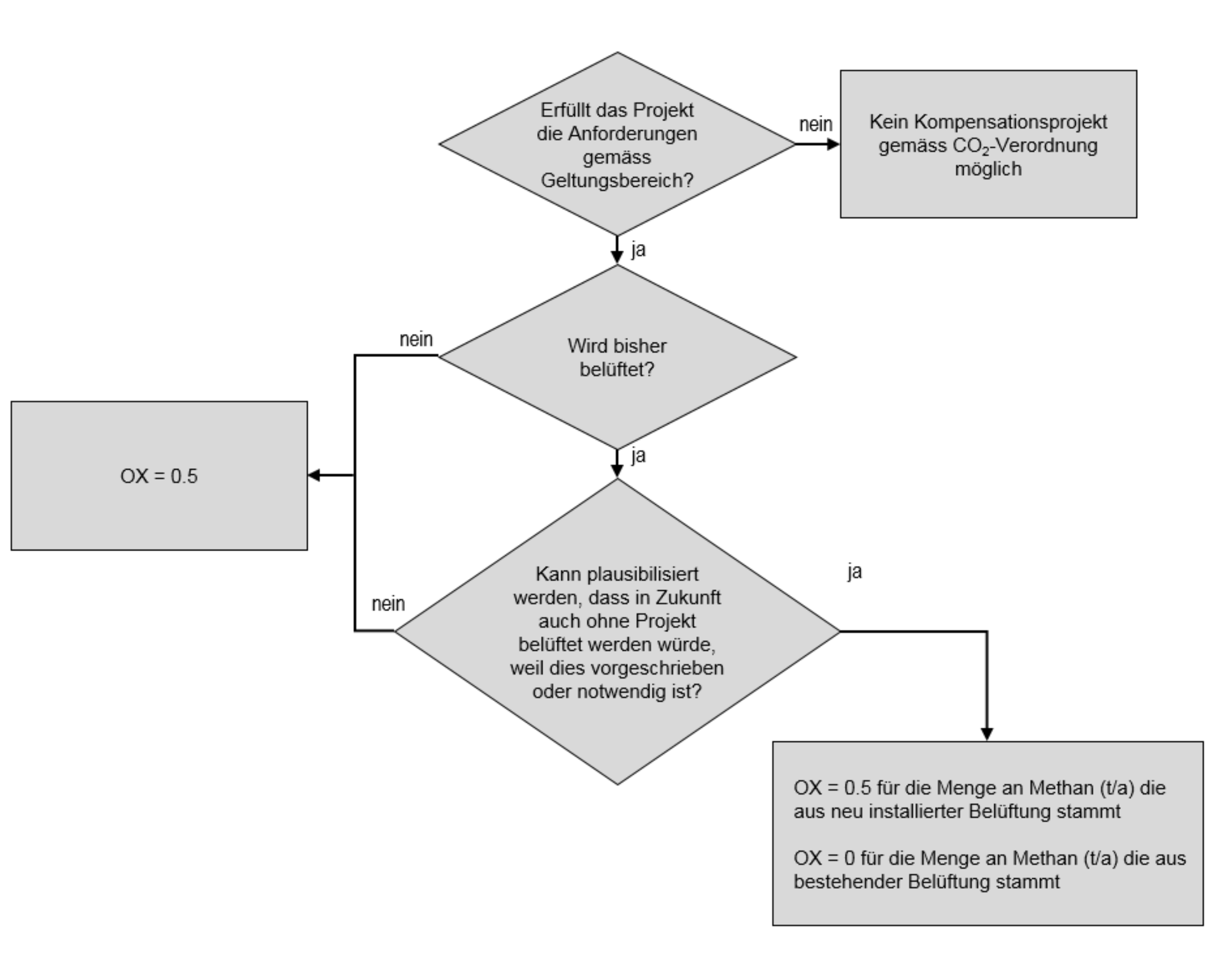
3.3 Ex-ante calculation of emission reductions
The emission reductions can be calculated ex-ante based on measurement data from the previous one to three years or calculated using the following formula:
ERex-ante,y,flare = (FE – OX) * SE * FODCH4,y * GWPeff,CH4 – PEy (1)
in which
ERex-ante,y,flare are the estimated emission reductions from lean gas treatment in year y (tCO2eq).
GWPeff,CH4 is the effective greenhouse gas potential of methane (22.25 tCO2eq / t CH4).
FE is the flare efficiency.
OX is the oxidation factor.
SE is the suction efficiency.
FODCH4,y is the quantity of methane calculated using a “first order decay” formula that is produced by the landfill in year y (t CH4); see formula (2).
PEy are the project emissions in year y
FODCH4,y = (16/12) * F * DOCf * ∑x ∑j Aj,x * DOCj *
Exp(-kj(y-x)) * (1 – Exp(-kj)) (2)
in which
y is the year for which the methane emissions are calculated.
x is the year in which the landfill was filled with a specific quantity of waste Aj,x of category j, which falls between OY and y.
16/12 is the molecular weight ratio of CH4 to C.
F = 0.5; percentage of methane in the methane/carbon dioxide mixture in the landfill gas.
DOCf is the percentage of biodegradable carbon that is degraded under anaerobic conditions (% by mass).
Aj,x is the quantity of waste in waste category j that was deposited in year x (t waste).
OY is the year the landfill was opened, the first year in which waste was deposited.
j is the waste category.
DOCj is the percentage of degradable organic carbon in the relevant waste category (t C / t waste).
kj is the degradation constant for the relevant waste category j (1/year).
3.4 Ex-post calculation of emission reductions
For new and existing degassing systems, the reduction in methane is calculated ex-post as follows:
ERex-post,y,flare = (FE – OX) * GWPeffCH4 * VDG,y * cCH4 * DCH4 – PEy (3)
in which
ERex-post,y,flare are the eligible emission reductions determined ex-post with the aid of the emissions measured during the lean gas treatment in year y (tCO2eq).
FE is the flare efficiency.
OX is the oxidation factor.
GWPeff,CH4 is the effective greenhouse gas potential of methane (22.25 tCO2eq/ tCH4).
VDG,y is the volume flow of landfill gas that is measured at the entry to the lean gas treatment process in year y (Nm3); this parameter is replaced in the monitoring by the value measured in accordance with number 4.
cCH4 is the methane content in the landfill gas (% by volume); this parameter is replaced in the monitoring by the value measured in accordance with number 4.
DCH4 is the methane density under standard conditions (0.0007202 tCH4/Nm3).
PEy are the project emissions in year y.
3.5 Calculation of the project emissions
The project emissions from operating the lean gas treatment process are calculated as follows based on the energy sources used:
PEy = EFGas * MGas,y (4)
in which
EFGas is the emission factor for the gas used [tCO2eq/Nm3]; this parameter is replaced in the monitoring by the value measured in accordance with number 4.
MGas,y is the expected quantity of gas burned in year y [Nm3]; this parameter is replaced in the monitoring by the value measured in accordance with number 4.
4 Requirements for the monitoring concept
1. For projects and programmes in accordance with this Annex, the monitoring report must be accompanied by the measurement results and documents listed in numbers 4.1–4.6.
2. The calculation of the emission reductions must be substantiated by the measurement results.
4.1 Flare efficiency
The flare efficiency (FE) value must be determined in the monitoring report as follows:
the percentage of methane that is effectively burned during flaring or generally oxidised in gas treatment processes must be stated;
the following procedure applies:
a value of 90 % must be used as the standard value for the combustion efficiency of a closed flare.
applicants may also use the manufacturer’s specifications, provided it can be shown that these have been complied with.
applicants may make their own measurements.
flare efficiency must be stated as a percentage (%);
its value must be determined each year.
4.2 Volume flow of landfill gases
When determining the volume flow (VDG,y) all the following requirements must be met:
the volume flow of the landfill gases must be determined;
measuring devices for determining volume flow must be used as the data source;
the measurement must be recorded in standard cubic metres (Nm3);
the measurement must be made continuously;
the form and regularity for calibrating the measuring devices must be specified in the first monitoring report.
4.3 Methane content of landfill gases
When measuring the methane content (cCH4), all the following requirements must be met:
the methane content in the landfill gas must be measured;
a methane measuring sensor must be used as the data source;
the measurement must be recorded as per cent by volume (Vol-%);
the measurement must be made continuously;
the form and duration for calibrating the measuring devices must be specified in the first monitoring report.
4.4 Newly installed degassing systems
A comprehensible explanation must be provided of how the collection system has been changed and what degassing systems in accordance with number 2 letter k are designated as new degassing systems.
4.5 Emission factor for gas
When determining the emission factor for the gas used (EFGas), all the following requirements must be met:
the Swiss greenhouse gas inventory or a comparable publication must be used as the data source. For liquid gas (butane, propane), Annex 10 must be used;
the factor must be recorded in tonnes of carbon dioxide equivalent per standard cubic metre (tCO2eq/Nm3) or in the case of liquid gas (butane, propane) in tonnes of carbon dioxide equivalent per tonne (tCO2eq/t).
4.6 Quantity of gas
When determining the quantity of gas (Mgas,y), all the following requirements must be met:
the quantity of gas burned for the lean gas treatment in year y must be determined;
volume flow measuring devices or the delivery documents for gas cylinders must be used as the data source;
the measurement must be recorded in standard cubic metres (Nm3) or by indicating the number of gas cylinders delivered, together with their content (l);
the measurement must be made continuously or when each delivery of gas cylinders is made;
quality assurance must be based on the manufacturer’s specifications.
Calculation of CO2 emissions from vehicles lacking the information listed in Article 24 or 25 paragraph 1
(Art. 25 para. 2)
1 Calculation of CO2 emissions
1.1 Petrol motor and manual gear change:
CO2 = 0.047 m + 0.561 p + 56,621
1.2 Petrol motor and automatic gear change:
CO2 = 0.102 m + 0.328 p + 9,481
1.3 Petrol motor and hybrid electric drive:
CO2 = 0.116 m – 57,147
1.4 Diesel motor and manual gear change:
CO2 = 0.108 m – 11,371
1.5 Diesel motor and automatic gear change:
CO2 = 0.116 m – 6,432
CO2: CO2 emissions (combined) in g/km
m: unladen weight of the vehicle in kg
p: maximum engine power in kW
2 Rounding of the CO2 emissions
The CO2 emissions are rounded to the nearest whole number as follows:
If the digit following the decimal point is 4 or less, then the number is rounded down.
If the digit following the decimal point is 5 or greater, then the number is rounded up.
Calculation of the individual target
(Art. 28 para. 1)
1 Calculation of the individual target for small-scale importers and manufacturers
1.1 For small-scale importers, the individual CO2 emissions target is calculated individually for each vehicle using the following formula and rounded to three decimal places:
Individual target for the vehicle: z + a ∙ (m – Mt-2) g CO2/km;
1.2 For large-scale importers, the individual target for the average CO2 emissions is calculated individually for each fleet of new vehicles using the following formula and rounded to three decimal places:
Individual target for the fleet of new vehicles: z + a ∙ (Mi,t – Mt-2) g CO2/km;
z: target value for CO2 emissions in accordance with Article 10 paras 1 and 2 of the CO2 Act:
for passenger cars: 130g CO2/km up to and including reference year 2019, 95g CO2/km from reference year 2020
for vans and light articulated vehicles: 147g CO2/km from reference year 2020
a: slope of the target value line:
for passenger cars: 0.0457 up to and including reference year 2019, 0.0333 from reference year 2020
for vans and light articulated vehicles: 0.096 from reference year 2020
m: unladen weight of passenger cars or, where applicable, of vans or of light articulated vehicles in kg (Art. 24 and 25)
Mi,t: average unladen weight of the importer’s passenger cars registered for the first time in the reference year or, where applicable, vans or light articulated vehicles of the large-scale importers in kg, rounded to three decimal places
Mt-2: average unladen weight of the passenger cars registered for the first time in Switzerland in the penultimate calendar year before the reference year or, where applicable, vans or light articulated vehicles in kg
2 Average unladen weight
2.1 Passenger cars
The average unladen weight of passenger cars registered for the first time in the following years amounted to:
2015:
1532 kg;
2016:
1563 kg;
2017:
1588 kg;
2018:
1601 kg.
2019:
1636 kg.
2.2 Vans and light articulated vehicles
The average unladen weight of vans and light articulated vehicles registered for the first time in the following years amounted to:
2018:
2056 kg.
2019:
2067 kg.
Sanction amounts for exceeding individual targets (Art. 13 para. 1 of the CO2 Act)
(Art. 29 para. 1)
1 Sanction amounts for the reference year 2017
The sanction amounts to be paid if the individual target is exceeded for the reference year 2017:
for the first gram of CO2/km (from 0.1 gram up to and including 1 gram) above the individual target: CHF 5.50;
for the second gram of CO2/km (from 1.1 gram up to and including 2 grams) above the individual target: CHF 16.50;
for the third gram of CO2/km (from 2.1 grams up to and including 3 grams) above the individual target: CHF 27.50;
for every additional gram of CO2/km (from 3.1 grams) above the individual target: CHF 103.50.
2 Sanction amounts for the reference year 2017
The sanction amounts to be paid if the individual target is exceeded for the reference year 2018:
for the first gram of CO2/km (from 0.1 gram up to and including 1 gram) above the individual target: CHF 5.50;
for the second gram of CO2/km (from 1.1 gram up to and including 2 grams) above the individual target: CHF 16.50;
for the third gram of CO2/km (from 2.1 grams up to and including 3 grams) above the individual target: CHF 27.50;
for every additional gram of CO2/km (from 3.1 grams) above the individual target: CHF 104.50.
3 Sanction amounts for the reference years 2019 and subsequent
The sanction amounts to be paid if the individual target is exceeded amount for each gram of CO2/km (from 0.1 grams):
for the reference year 2019:
CHF 111.00;
for the reference year 2020:
CHF 109.00;
für for the reference year 2021:
CHF 103.50.
Installation operators obliged to participate in the ETS
(Art. 40 para. 1)
An installation operator that engages in at least one of the following activities must participate in the ETS:
combustion of fossil-fuel or partial fossil-fuel fuels with a total rated thermal input of over 20 MW; excluded is the combustion of fossil-fuel or partial fossil-fuel fuels in installations whose main function is the disposal of municipal waste in accordance with Article 3 letter a of the WastMA286;
refining of mineral oil;
production of coke;
roasting or sintering, including palletisation, of metal ore, including sulphide ore;
production of pig iron or steel (primary or secondary fusion) including continuous casting, with a capacity of over 2.5 tonnes per hour;
production or processing of ferrous metals including ferro-alloys in which combustion units with a total rated thermal input of over 20 MW are operated;
production of primary aluminium;
production of secondary aluminium in which combustion units with a total rated thermal input of over 20 MW are operated;
production or processing of non-ferrous metals, including production of alloys, refining, foundry casting, etc., in which combustion units with a total rated thermal input (including fuels used as reducing agents) of over 20 MW are operated;
production of cement clinker in rotary kilns with an installed production capacity of over 500 tonnes per day or in other furnaces with a production capacity of over 50 tonnes per day;
production of lime or calcination of dolomite or magnesite in rotary kilns or in other furnaces with an installed production capacity of over 50 tonnes per day;
manufacture of glass including glass fibre with a melting capacity of over 20 tonnes per day;
manufacture of ceramic products by firing, in particular roofing tiles, bricks, refractory bricks, tiles, stoneware or porcelain, with an installed production capacity of over 75 tonnes per day;
manufacture of mineral wool insulation material using glass, rock or slag with a melting capacity of over 20 tonnes per day;
drying or calcination of gypsum or production of plaster boards and other gypsum products in which combustion units with a total rated thermal input of over 20 MW are operated;
production of pulp from timber or other fibrous materials;
production of paper or cardboard with an installed production capacity of over 20 tonnes per day;
production of carbon black involving the carbonisation of organic substances such as oils, tars, cracker and distillation residues, where combustion units with a total rated thermal input of over 20 MW are operated;
production of nitric acid;
production of adipic acid;
production of glyoxal and glyoxylic acid;
production of ammonia;
production of bulk organic chemicals by cracking, reforming, partial or full oxidation or by similar processes, with an installed production capacity of over 100 tonnes per day;
production of hydrogen (H2) and synthesis gas by reforming or partial oxidation with an installed production capacity of over 25 tonnes per day;
production of soda ash (Na2CO3) and sodium bicarbonate (NaHCO3).
Activities that qualify for participation in the ETS or for exemption from reduction obligations
(Art. 42 para. 1 let. a and 66 para. 1 let. a and b and 3 let. a and b)
cultivation of plants in greenhouses;
quarrying of rock, soil or other mining activities;
processing of agricultural and fishery products for the production of food products or animal feed products;
3bis. fattening of pigs and poultry;
manufacture of beverages;
manufacture of tobacco products;
manufacture and cleaning of textiles;
manufacture of veneer sheets, plywood, wood fibre and wood-based panels as well as pellets;
manufacture of wood-fibre pulp, pulp, paper, paperboard, cardboard, products made out of paper and paperboard such as corrugated paper, packing materials, hygiene products and wallpapers, manufacture of drying-intensive print products (without printing of newspapers, heliographs and reprography);
manufacture of coke and refined petroleum products;
manufacture of chemical and pharmaceutical products and the associated technology development;
manufacture of plastic products;
manufacture of glass, glass products and ceramics, processing of rock and soils (without processing and treatment of natural stone) and the manufacture of asphalt products;
manufacture and processing of basic metals, heat treatment and coating of metals as well as painting of bodywork, except in mechanical workshops and locksmith shops;
manufacture of central heating, metal forging and roll-forming, manufacture of wire products, chain and springs;
manufacture of generators, transformers, domestic appliances and electrical wires and cables;
manufacture of watches and clocks;
manufacture of machines for activities described in numbers 1–16, of pumps, compressors, automobiles, other vehicles and motors;
operation of public baths, artificial ice-skating rinks, tourist hotels and steam-driven locomotives and ships;
warehousing operations in distribution centres;
production of fossil-fuel-generated heating or cooling energy, possibly coupled with the production of electricity that feeds into regional district heating or cooling networks or is delivered to installation operators that are engaged in the activities listed in numbers 1–19 and 21.
cleaning of barrels, containers and other packaging that are used in connection with the activities listed in this Annex.
Calculation of the maximum available quantity of emission allowances for installation operators participating in the ETS
(Art. 45 para. 1)
The maximum total quantity of emission allowances available each year to all Installation operators participating in the ETS as a whole is calculated as follows:
Capi = [∑ ØFZ + ∑ Øemissions] * [1 – (i-2010) * 0.0174]
Capi Emissions cap for the year i
∑ ØFZ: Sum of the average emission allowances allocated annually in the 2008–12 period to installations that were already taken into account in the ETS in the 2008–12 period and will again be taken into account in the ETS starting in 2013
∑ Øemissions: Sum of the average greenhouse gases emitted annually in the 2009–11 period by installations and the greenhouse gas emissions that will be newly taken into account in the ETS starting in 2013.
Calculation of emission allowances to be allocated free of charge for installation operators in the ETS
(Art. 46 para. 1 and 46c para. 3)
1 Benchmarks
1.1 The quantity of emission allowances to be allocated free of charge annually is based on the following product benchmarks:
Product | Product benchmark (number of emission allowances per tonne of manufactured products) |
|---|---|
Coke | 0.286 |
Iron ore sinter | 0.171 |
Hot metal | 1,328 |
Pre-bake anodes | 0.324 |
Aluminium | 1,514 |
Grey cement clinker | 0.766 |
White cement clinker | 0.987 |
Lime | 0.954 |
Dolomite lime | 1,072 |
Sintered dolomite | 1,449 |
Float glass | 0.453 |
Bottles and containers made of clear glass | 0.382 |
Bottles and containers made of coloured glass | 0.306 |
Products made of continuous glass fibre | 0.406 |
Facing bricks | 0.139 |
Paving bricks | 0.192 |
Roofing tiles | 0.144 |
Spray-dried powder | 0.076 |
Gypsum | 0.048 |
Dried secondary gypsum | 0.017 |
Short-fibre sulphate pulp | 0.12 |
Long-fibre sulphate pulp | 0.06 |
Sulphite pulp, thermo-mechanical and mechanical pulp | 0.02 |
Pulp made of recycled paper | 0.039 |
Newsprint paper | 0.298 |
Uncoated fine paper | 0.318 |
Coated fine paper | 0.318 |
Tissue paper | 0.334 |
Test liner and fluting | 0.248 |
Uncoated paperboard | 0.237 |
Coated paperboard | 0.273 |
Nitric acid | 0.302 |
Adipic acid | 2,79 |
Vinyl chloride monomer (VCM) | 0.204 |
Phenol/ acetone | 0.266 |
S-pvc | 0.085 |
E-pvc | 0.238 |
Soda ash | 0.843 |
Refinery products | 0.0295 |
Carbon steel obtained using the electric arc process | 0.283 |
High-alloy steel obtained using the electric arc process | 0.352 |
Cast iron | 0.325 |
Mineral wool | 0.682 |
Gypsum paperboard | 0.131 |
Industrial soot («Carbon Black») | 1,954 |
Ammonia | 1,619 |
Steam cracking | 0.702 |
Aromatics | 0.0295 |
Styrene | 0.527 |
Hydrogen | 8,85 |
Synthetic gas | 0.242 |
Ethylene oxide and ethylene glycol | 0.512 |
1.2 If no product benchmark applies, then the quantity of emission allowances to be allocated free of charge annually is calculated based on the heat benchmark as follows:
62.3 emission allowances per TJ of measurable heat.
1.3 If neither a product benchmark nor a heat benchmark applies, then the quantity of emission allowances to be allocated free of charge annually is calculated on the basis on the following thermal-fuel benchmark:
56.1 emission allowances per TJ heating value of the used thermal fuels.
1.4 If none of the benchmarks described in numbers 1.1–1.3 is applicable, then the quantity of emission allowances to be allocated free of charge annually is calculated on the basis of 0.97 times the median of the annual process emissions in the years 2005–2008 or 2009–2010.
1.5 For the use of gases that come from processes and contain a high proportion of partially oxidised carbon (residual gas), there is an additional free-of-charge allocation to compensate for higher CO2 emissions and lower efficiency in the use of residual gases in comparison with natural gas. This allocation is only made if the residual gas is created outside of a sub-installation with product benchmark and is used within the installation in the ETS to generate measurable or non-measurable heat or for the production of electricity.
1.6 No emission allowances are allocated free of charge for heat resulting from the manufacture of nitric acid.
2 General calculation of the emission allowances to be allocated free of charge
2.1 The free-of-charge allocation is calculated per sub-installation for each year of participation in the ETS, subject to number 4, according to the following formula:
Allocationi = BM * AR * AFi * SKFi
Allocationi Allocation in year i
BM Benchmark
AR Activity rate (referring to the relevant benchmark)
AFi Adaptation factor in year i in accordance with Annex 9 no 3
SKFi Cross-sectoral correction factor in year i
2.2 The benchmark is determined per sub-installation on the basis of the benchmark hierarchy described in numbers 1.2–1.4.
2.3 The activity rate refers to the relevant benchmark. It is determined at the initial allocation for each sub-installation and is adapted for each significant capacity change. The activity rate for the initial allocation generally corresponds to the median annual values in the years 2005–2008 or 2009–2010. If no sufficiently long representative reference period exists for the derivation of the activity rate or a significant capacity change has occurred, then the installed capacity as well as a decisive load factor are used to derive the activity rate relevant for allocation.
2.4 The installed capacity of an installation refers to the installation’s sub-installations. It is a measure that is used to assess the materiality of capacity changes and to calculate the free-of-charge allocation of new installations and significantly modified installations. The FOEN calculates the installed capacity of an installation on the basis of the two highest monthly activity rates in a predefined time period.
3 Adaptation factors
3.1 For sectors and subsectors that are not listed in the Annex to Decision 2014/746/EU287, the quantities calculated in accordance with numbers 2 and 4 are multiplied by the following of adaptation factors:
3.1.1 for the year 2013: 0.8
3.1.2 for the year 2014: 0.7286
3.1.3 for the year 2015: 0.6571
3.1.4 for the year 2016: 0.5857
3.1.5 for the year 2017: 0.5143
3.1.6 for the year 2018: 0.4429
3.1.7 for the year 2019: 0.3714
3.1.8 for the year 2020: 0.3
3.2 If an installation operator delivers heat to a third party, then the customer’s adaptation factor is decisive.
4 Special adaptation factors for thermal fuels and electricity operated production processes
4.1 No emission allowances are allocated free of charge for indirect emissions from the use of electricity. For benchmarks of production processes that can be operated with either thermal fuels or electricity, 0.465 t CO2 per MWh will be deducted for the indirect emissions from electricity used.
The quantity of emission allowances to be allocated free of charge annually is calculated in these cases as follows:
Allocationi = (Edirect / (Edirect + Eindirect)) * BM * AR * AFi * SKFi
Allocationi Allocation in year i
Edirect Direct emissions from within the corresponding sub-installation with product benchmark in the selected reference period. These include emissions from heat consumed within the sub-installation that was obtained directly from other ETS operators.
Eindirect Indirect emissions from heat consumed with the corresponding sub-installation with product benchmark that was obtained from a third party outside the ETS, as well as the electricity consumed within the sub-installation in the selected reference period.
BM Benchmark
AR Activity rate (referring to the relevant benchmark)
AFi Adaptation factor in year i in accordance with Annex 9 no 3
SKFi Cross-sectoral correction factor in year i
4.2 Production processes that are covered by the following product benchmarks can be operated either with thermal fuels or electricity:
4. 2.1 Refinery products
4. 2.2 Carbon steel obtained using the electric arc process
4. 2.3 High-alloy steel obtained using the electric arc process
4. 2.4 Cast iron
4. 2.5 Mineral wool
4. 2.6 Gypsum paperboard
4. 2.7 Industrial soot («Carbon Black»)
4. 2.8 Ammonia
4. 2.9 Steam cracking
4. 2.10 Aromatics
4. 2.11 Styrene
4. 2.12 Hydrogen
4. 2.13 Synthetic gas
4. 2.14 Ethylene oxide and ethylene glycol
Motor fuels for which CO2 emissions must be compensated
(Art. 86 para. 1 and 89 para. 2)
Customs tariff number288 | Description | Emission factor t CO2 per 1000 kg | Emission factor t CO2 per TJ | Emission factor t CO2 per m3 |
| Petroleum spirit and fractions thereof, and mineral oil content in mixtures of this number, not including aviation fuel | 3.15 | 73.80 at a calorific value (Hu) of 42.6 MJ/kg | 2.32 with a density* of 737 kg/m3 |
| Aviation fuel | 3.17 | 72.50 at a calorific value (Hu) of 43.7 MJ/kg | 2. 27 with a density* of 715 kg/m3 |
| Petroleum oil, incl. aviation petrol | 3.14 | 72.80 at a calorific value (Hu) of 43.2 MJ/kg | 2.51 with a density* of 799 kg/m3 |
| Diesel oil, and mineral oil content in mixtures of this number | 3.15 | 73.30 at a calorific value (Hu) from 43.0 MJ/kg | 2.62 with a density* of 830 kg/m3 |
| Mineral oil content in mixtures of this number | 3,15 | 73,30 at a calorific value (Hu) of 43,0 MJ/kg | 2,62 with a density* of 830 kg/m3 |
| Liquefied natural gas | 2.58 | 56.4 at a calorific value (Hu) of 45.7 MJ/kg | 1.16 with a density** of 451 kg/m3 |
| Natural gas in gaseous state | 2.58 | 56.4 at a calorific value (Hu) from 45.7 MJ/kg | 0.002 with a density*** of 0.795 kg/m3 |
| LPG (butane, propane) | 3.01 | 65.50 at a calorific value (Hu) of 46.0 MJ/kg | 1.63 with a density* of 540 kg/m3 |
| Mineral oil content in mixtures of this number | 3,15 | 73,80 at a calorific value (Hu) of 42,6 MJ/kg | 2,32 with a density* of 737 kg/m3 |
| Mineral oil content in mixtures of this number | 3,15 | 73,30 at a calorific value (Hu) of 43,0 MJ/kg | 2,62 with a density* of 830 kg/m3 |
| ||||
| ||||
|
Tariff of the CO2 levy for thermal fuels: 94 francs per tonne CO2
(Art. 94 para. 2)
Customs tariff number289 | Description | Levy |
per 1000 kg | ||
| Coal; briquettes, ovoids and similar solid fuels manufactured from coal: | |
| ||
| – – anthracite | 226.60 |
| – – bituminous coal | 226.60 |
| – – other coal | 226.60 |
|
| 226.60 |
| Lignite, whether agglomerated or not, excluding jet: | |
| – lignite, whether agglomerated or not, but not agglomerated | 217.90 |
| – agglomerated lignite | 217.90 |
| Coke and semi-coke of coal, of lignite or of peat, whether or not agglomerated; retort carbon | 272.60 |
per 1000 l | ||
| Petroleum oils or oils obtained from bituminous minerals, other than crude; preparations not elsewhere specified or included, containing by weight 70% or more of oils or of oils obtained from bituminous minerals, these oils being the basic constituents of the preparations; waste oils: | |
| ||
– – light oils and preparations: | ||
– – – for use as fuel: | ||
| – – – – petroleum spirit and fractions thereof | 222.70 |
| – – – – white spirit | 222.70 |
| – – – – other | 222.70 |
– – other: | ||
– – – for use as fuel: | ||
| – – – – petroleum oil | 241.00 |
| – – – – heating oils: | |
– – – – – extra light | 254.40 | |
per 1000 kg | ||
– – – – – medium, having a sulphur content | 304.30 | |
| – – – – other distillates and products: | |
Customs tariff number | Description | Levy in CHF |
per 1000 l | ||
1999 | – – – – – gas oil | 254.40 |
per 1000 kg | ||
– – – – – other | 304.30 | |
per 1000 l | ||
| ||
| – – for other uses (only fossil-fuel portion) | 254.40 |
| Petroleum gases and other gaseous hydrocarbons: | |
– liquefied: | ||
– – natural gas: | ||
| – – – other | 115.20 |
– – propane: | ||
| – – – other | 145.90 |
– – butane: | ||
| – – – other | 169.00 |
– – ethylene, propylene, butylene and butadiene: | ||
| – – – other | 187.20 |
– – other: | ||
| – – – other | 187.20 |
per 1000 kg | ||
– in gaseous state: | ||
– – natural gas: | ||
| – – – other | 255.40 |
– – other: | ||
| – – – other | 268.80 |
| Petroleum coke, petroleum bitumen and other residues of petroleum oils or of oils obtained from bituminous minerals: | |
– petroleum coke: | ||
| – – not calcined | 279.40 |
| – – calcined | 279.40 |
per 1000 l | ||
2905. | Acyclic alcohols and their halogen, sulfo-, nitro- or nitroso derivatives: – saturated monovalent alcohols: – – methanol (methyl alcohol): | |
1190 | – – – other (only fossil-fuel portion) | 104.60 |
| Biodiesel and mixtures thereof, not containing or containing less than 70 % by weight of petroleum oils or oils obtained from bituminous minerals: | |
| – other (only fossil-fuel portion) | 254.40 |
... | thermal fuels from other fossil-fuel source materials | 222.70 |
Direct use of geothermal energy for the provision of heat
(Art. 112–113b)
1 Prospecting and development
1.1 Prospecting covers investigations which on the one hand serve to indirectly characterise the subsoil of a presumed geothermal reservoir and, on the other hand, determine the above-ground site and the underground landing point of an exploration well.
1.2 Development covers exploration by drilling and extracting hot water and the possibility of returning the extracted water (via a second drill hole) into the geothermal reservoir.
2 Eligible investment costs
2.1 Eligible costs comprise only the investment costs for prospecting that are actual costs and are directly necessary for the economic and appropriate implementation of the project and which cover:
the acquisition of new geodata in the prospecting area;
work required for the acquisition of new geodata;
analysis and interpretation.
2.2 Eligible costs comprise only the investment costs for development that are actual costs and are directly necessary for the economic and appropriate implementation of the project and which cover:
the preparation, construction and dismantling of the drilling site;
drilling, including pipework, cementation and completion for the planned exploration well, the well for returning extracted water and microseismic monitoring wells;
well stimulation;
borehole tests;
borehole measurements including instrumentation;
analyses of substances found;
geological monitoring, data analysis and interpretation.
2.3 The costs incurred within the framework of official processes concerning prospecting and development shall not constitute eligible costs.
3 Procedure to support prospecting
3.1 Application
The application must provide information on the technical, economic, legal, safety, environmental protection and organisational aspects of the project, in particular on:
the current state of knowledge in the exploration area including all existing processed geodata, analyses and interpretations;
the geological prospecting planned for determining the sites and landing points of a well and the location and characterisation of a geothermal well, and the expected added value in terms of an increase in the probability of successful development;
utilisation concepts for successful prospecting and preliminary feasibility studies;
detailed schedules and cost estimates with deviations of no more than 20 per cent;
the measures planned to identify hazards and risks to health, occupational and operational safety, and the environment, in particular drinking water resources, and the measures planned to reduce these risks to a level that is as low, reasonable and practicable as possible.
3.2 Examination of the application
3.2.1 The SFOE BFE shall appoint a representative of the Federal Office of Topography (swisstopo) to the independent panel of experts, in particular to assess the geoscientific project components and the added value for exploration in Switzerland.
3.2.2 The panel of experts shall examine and assess the application on the basis of the information referred to in point 3.1 and in particular with regard to:
the planned prospecting work and project management;
the technical and qualitative state of the planned work and the degree of innovation;
the question of how much the prospecting work increases the probability of finding and closing a geothermal reservoir;
the added value for exploring the substrate of Switzerland for geothermal reservoirs;
the management of risks to health, occupational and operational safety and the environment.
3.2.3 If the panel of experts assesses the project positively, it shall in particular make a recommendation to the SFOE on:
the expected increase in the probability of finding a geothermal reservoir;
the deadlines for the project stages;
the amount of the contribution to be granted for prospecting;
the appointment of a representative of swisstopo as project supervisor.
3.3 Contract
Where the contribution for prospecting can be granted, the following points in particular shall be regulated in the contract under Article 113 paragraph 5:
the milestones to be reached by the applicant and the deadlines to be met;
the applicant’s obligation to inform the SFOE, in particular with regard to financial reports, final accounts and any changes to the project;
the scope, conditions and due date of the contribution for prospecting;
subject to cantonal monopolies, the transfer, free of charge, of the installation to the Confederation and the granting to the Confederation of the right to purchase the property if a project is discontinued and not used for any other purpose;
the disclosure of all financial data necessary to calculate any losses or gains under Article 113b;
reasons leading to termination of the contract;
further requirements.
3.4 Project implementation and completion
3.4.1 The project engineer carries out the planned prospecting work.
3.4.2 The project supervisor oversees the project during prospecting work; he or she evaluates the results and reports regularly to the panel of experts.
3.4.3 If the milestones or deadlines under point 3.3 letter a are not met, the SFOE may terminate the contract immediately.
3.4.4 After completion of the work, the panel of experts shall evaluate the results of the prospecting work for the SFOE and assess them with regard to the expected increase in the probability of finding a suspected geothermal reservoir.
4 Procedures to support development
4.1 An application for support for development may only be submitted if prospecting has been carried out beforehand in the area concerned and a prospecting report regarding the probability of a presumed geothermal reservoir is available.
4.2 Application
The application must provide information on the technical, economic, legal, safety, environmental protection and organisational aspects of the project, and in particular on:
the detailed drilling, completion, measuring and testing programme for all planned drilling;
detailed schedules and cost estimates with deviations of no more than 20 per cent;
the expected properties of the presumed geothermal reservoir, in particular its temperature in the borehole at the level of the reservoir and its transport properties;
the planned use of the wells and the geothermal reservoir if the results do not meet expectations;
the measures planned to identify hazards and risks to health, occupational and operational safety, and the environment, in particular drinking water resources, and the measures planned to reduce these risks to a level that is as low, reasonable and as practicable as possible;
the innovations planned to open up geothermal reservoirs in Switzerland in a reliable and promising manner;
the importance of development works in relation to the exploration of Switzerland’s subsoil for geothermal reservoirs;
the intended legal form or name and business of the operating installation operator;
the financing and administrative costs of the development, construction, extension, operation and dismantling phases;
the use of the hot groundwater obtained on the basis of a utilisation concept, a description of the planned heat consumers and their integration into the project, including the expected reductions in CO2 emissions.
4.3 Examination of the application
4.3.1 The SFOE BFE shall appoint a representative of swisstopo to the independent panel of experts, in particular to assess the geoscientific project components and the added value for exploration in Switzerland.
4.3.2 The panel of experts shall examine and assess the application on the basis of the information referred to in point 4.2 and in particular with regard to:
the expected properties of the geothermal reservoir, in particular with regard to the temperature in the borehole at the level of the reservoir and its transport properties;
the technical and qualitative state of the planned work and the degree of innovation;
the added value for exploring the substrate of Switzerland for geothermal reservoirs;
the management of risks to health, occupational and operational safety and the environment.
4.3.3 If the panel of experts assesses the application positively, it shall in particular make a recommendation to the SFOE on:
the expected temperature of the reservoir in the borehole at the level of the reservoir and its transport properties;
the deadlines for the project stages;
the amount of the development contribution to be granted;
the appointment of an independent expert to accompany the project.
4.4 Contract
Where the contribution for development may be granted, the following points in particular shall be settled in the contract under Article 113 paragraph 5:
the milestones to be reached by the applicant and the deadlines to be met;
the applicant’s obligation to inform the SFOE, in particular with regard to financial reports, final accounts and any changes to the project;
scope, conditions and due date of the contribution for development;
subject to cantonal monopolies, the transfer, free of charge, of the installation to the Confederation and the granting to the Confederation of the right to purchase the property if a project is discontinued and not used for any other purpose,;
the disclosure of all financial data necessary to calculate any losses or gains under Article 113b;
reasons leading to termination of the contract;
further requirements.
4.5 Project implementation and completion
4.5.1 The project engineer carries out the planned development work.
4.5.2 The project supervisor oversees the project during prospecting work; he or she evaluates the results, in particular with regard to the temperature and transport properties of the reservoir, and reports regularly to the panel of experts.
4.5.3 If the milestones or deadlines under point 4.4 letter a are not met, the SFOE may terminate the contract immediately.
4.5.4 No later than six months after completion of the development work, the panel of experts shall evaluate the results of the development work.
4.5.5 The SFOE shall inform the project engineer of the results of the assessment, in particular those relating to the geothermal reservoir.
5 Geodata
5.1 The applicant shall make the respective geodata available free of charge to swisstopo and to the canton where the prospecting and development is taking place in accordance with the technical specifications of swisstopo no later than six months after the data was collected.
5.2 swisstopo may use and process these geodata in accordance with the objectives of the Geoinformation Act of 5 October 2007290 and the Geological Survey Ordinance of 21 May 2008291; the cantons with prospecting and development sites may do so in accordance with their respective regulations.
5.3 It shall make the primary and the processed primary geodata available to the public within 24 months after completion of prospecting and within 12 months after completion of development.
Aircraft operators obliged to participate in the ETS
(Art. 46d)
Aircraft operators are obliged to participate in the ETS if they perform the following flights:
domestic flights in Switzerland;
flights from Switzerland to member states of the EEA.
The following flights are exempted:
flights performed exclusively for the transport on official mission of a reigning monarch and his/her immediate family, heads of state, heads of government and government ministers, where this is substantiated by an appropriate status indicator in the flight plan;
military, customs and police flights;
flights relating to search and rescue, fire-fighting flights, humanitarian flights and emergency medical service flights;
flights performed exclusively under visual flight rules as defined in Annex 2 of the Convention of 7 December 1944292 on International Civil Aviation;
flights terminating at the aerodrome from which the aircraft has taken off and during which no planned intermediate landing has been made;
training flights performed exclusively in order to acquire or maintain a licence, or a rating in the case of cockpit flight crew, where this is substantiated by an appropriate remark in the flight plan provided that the flights are not for the transport of passengers and/or cargo or for the positioning or ferrying of aircraft;
flights performed exclusively for the purpose of scientific research;
flights performed exclusively for the purpose of checking, testing or certifying aircraft or airborne or ground-based equipment;
flights performed by aircraft with a certified maximum take-off mass of less than 5,700 kilograms;
flights performed by commercial operators in each of three consecutive four-month periods if they perform fewer than 243 flights in accordance with number 1 or if their total annual emissions of CO2 are below 10,000 tonnes;
flights performed by non-commercial operators if the total annual emissions of CO2 from the flights performed by these operators in accordance with number 1 are below 1,000 tonnes;
flights from Switzerland to an aerodrome in the following territories:
1. Guadeloupe,
2. French Guiana,
3. Martinique,
4. Mayotte,
5. Réunion,
6. Saint Martin,
7. Azores,
8. Madeira,
9. Canary Islands.
The exemptions cited in number 2 letters j and k do not apply to aircraft operators subject to the European ETS.
For the allocation of flights to the four-month periods cited in number 2 letter j, it is the local take-off time of each flight that is of relevance.
Competent authority for ETS participants
(Art. 46d para. 1 and 2, 51 para. 1, 2 and 4, 52 para. 1, 6 and 7, 53 para. 1 and 2, 55 para. 2 and 130 para. 1)
1 Installation operators
For installation operators participating in the ETS, the FOEN is the competent authority.
2 Aircraft operators
2.1 For aircraft operators obliged to participate in the ETS, the state competent for their administration is determined in accordance with the Regulation (EC) No 748/2009.293
2.2 Decisive for the administration of aircraft operators is:
a. which state issued the operating licence; or
b. the highest attributed estimated value for CO2 emissions of the respective aircraft operator in comparison with the other states.
2.3 In the case of administration by Switzerland, the FOEN is the competent authority.
Calculation of the maximum available quantity of emission allowances and the quantity of emission allowances to be allocated free of charge for aircraft
(Art. 46e and 46f)
The quantity of emission allowances is based on the following benchmark:
0.000642186914222035 emission allowances per tonne-kilometre
The maximum quantity of emission allowances for aircraft available as a whole in 2020 is calculated as follows:
Cap2020 = ∑tkmCH-ETS * BM * 100 / 82
Cap2020 Emissions cap for 2020
∑tkmCH-ETS Sum of tonne-kilometres in 2018 in the Swiss ETS
BM Benchmark
This quantity of emission allowances is used as follows:
82 per cent is allocated to aircraft operators free of charge;
15 per cent is withheld for the auction;
3 per cent is withheld for new or fast-growing aircraft operators.
The free-of-charge allocation is calculated per aircraft operator for 2020 according to the following formula:
Allocation = ∑tkmoperator * BM
∑tkmoperator Sum of the tonne-kilometres in 2018 of the operator in the Swiss ETS
BM Benchmark
In 2020, the quantity of emission allowances withheld for this year in accordance with number 3 letter c will be cancelled.
Requirements for the monitoring plan
(Art. 51)
1 Monitoring plan for installation operators
The monitoring plan must specify how the installation operator ensures that:
standardised or other established procedures are used for the measurement or calculation of greenhouse gas emissions;
the greenhouse gas emissions are as completely, consistently and accurately recorded as is technically and operationally possible and economically feasible;
the measurement, calculation and documentation of greenhouse gas emissions are traceable and transparent.
2 Monitoring plan for aircraft operators
2.1 The monitoring plan must guarantee that all flights for which CO2 emission data have to be collected are included and that the CO2 emissions for each flight are calculated accurately. The emissions are calculated in accordance with no. 3.
2.2 The monitoring plan must include the following information:
a. the details required to identify the aircraft operator;
b. the details required to identify the aircraft operated and fuel type assigned to each type of aircraft;
c. a description of the methodology for ensuring the complete acquisition of data for all aircraft for which data have to be recorded;
d. a description of the methodology for ensuring the complete recording of all flights for which data have to be recorded;
e. a description of the methodology for calculating the CO2 emissions for each flight.
2.3 In the case of aircraft operators that generate CO2 emissions of more than 25,000 tonnes per year, the monitoring plan must also include the following information:
a. a procedure for recording the fuel consumption of each aircraft;
b. a methodology for eliminating data gaps.
2.4 In the event of a change in the status of the aircraft operator in accordance with Article 52 paragraph 5 (qualification as a small emitter) the monitoring plan must be resubmitted to the FOEN for evaluation.
3 Calculation of the CO2 emissions of aircraft
3.1 The CO2 emissions in tonnes are calculated according to the following formula:
CO2 emissions [f CO2] = fuel consumed [f fuel] x emission factor [f CO2/f fuel].
3.2 The following emission factors [f CO2/f fuel] apply to the following fuels:
Kerosene (jet A-1 or jet A):
3.15
Jet B:
3.10
Aviation gasoline (AvGas):
3.10
3.3 The emission factor of biomass fuels is zero provided the biomass used meets the sustainability criteria in accordance with Article 17 of the Directive 2009/28/EC294.
Requirements for the monitoring report
(Art. 52)
1 Monitoring report for installation operators
The monitoring report must contain:
information about the progression of greenhouse gas emissions;
information about the progression of production volumes;
an accounting of thermal fuels;
information about any changes in installed capacities.
1.2 The data must be shown in a summary table with comparative data of the previous years. The FOEN issues guidelines on the form of the monitoring report.
2 Monitoring report for aircraft operators
2.1 The monitoring report must contain:
the information required to identify the aircraft operator;
the information required to identify the verifier responsible for verifying the monitoring report unless the aircraft operator is exempted from the verification obligation as a small emitter;
a reference to the approved monitoring plan and a description and substantiation of any deviations from the underlying monitoring plan;
the information required to identify the aircraft used;
the total number of flights recorded;
the emission factor and fuel consumption for each fuel type for which the CO2 emissions are calculated;
the total of all CO2 emissions for flights for which data have to be recorded and which were performed by the operator in the calendar year, broken down by state of departure and state of arrival and broken down by Swiss ETS and European Union ETS;
in the event of data gaps, a description of the reasons for the data gaps, the method used to estimate the substitute data and the emissions calculated on the basis of it;
for each aerodrome pair, the ICAO aerodrome designation and the number of flights for which the data have to be recorded and the respective annual emissions.
2.2 Small emitters under Article 54 paragraph 1 of Regulation (EU) No 601/2012295 may estimate their fuel consumption using an instrument for small emitters in accordance with Article 54 paragraph 2 of Regulation (EU) No 601/2012.
Verification of the monitoring reports of aircraft operators and requirements to be met by the verifier
(Art. 52)
1 Duties of the verifier and the aircraft operator
1.1 The verifier shall verify the reliability, credibility and accuracy of the monitoring systems, the submitted data and other information as specified in Annex 18 number 2. In particular it shall ensure that the data permit the calculation of the CO2 emissions.
1.2 The aircraft operator shall grant the verifier access to all data and documentation that are required for the verification procedure. In particular, the aircraft operator shall obtain from Eurocontrol the necessary flight operator data or equivalent data and make them available to the verifier.
2 Specific requirements concerning verification
2.1 The verifier shall ensure that all flights have been taken into account:
for which the aircraft operator is responsible;
that have in fact been performed;
for which data have to be recorded in accordance with this Ordinance.
2.2 For this purpose the verifier shall use the flight plan data and the data obtained by the aircraft operator from Eurocontrol or other sources.
3 Verification steps
The verification of monitoring reports shall be carried out as follows:
3.1 Analysis of all activities carried out by the aircraft operator (strategic analysis);
3.2 Performance of random checks in order to determine the reliability of the submitted data and other information (process analysis);
3.3 Analysis of error risk relating to the utilised data, and examination of the procedures for limiting error risk (risk analysis);
3.4 Preparation of a verification report in which it is stated whether the monitoring report meets the requirements of this Ordinance. The verification report shall list all relevant aspects of the activities carried out within the scope of the verification procedure.
4 Requirements to be met by the verifier
4.1 The verifier must be accredited for the mandated verification activity in accordance with:
the Accreditation and Designation Ordinance of 17 June 1996;296 or
Regulation (EC) No 765/2008297 and Implementing Regulation (EU) 2018/2067298.
4.2 The verifier must be independent of the aircraft operator and perform its duties professionally and objectively.
4.3 The verifier must be able to demonstrate that it possesses the required competence to verify CO2 emission data in the civil aviation sector and is familiar with the way in which all information for the monitoring report is produced, in particular with respect to the acquisition, calculation and transmission of data.
4.4 The verifier must be familiar with all the relevant provisions and applicable legal and administrative regulations.